
Where Unity Is Strength
Header
Above image: Gurpal Singh Virdi

Gurpal Singh Virdi faced religious discrimination on 20th January 2026, when he was asked to accompany students and a teacher on a school trip to a company called Belazu, in Greenford. Mr Virdi is an author and a respected member of the British Sikh community. He has served as an elected official and as senior police officer and played a leading role in the Metropolitan Police Sikh Association.

During the school visit, Gurpal was refused entry because he was wearing his kara, an article of faith he always wears. The kara is a steel or iron bangle worn by Sikhs and is one of the 5Ks, the recognised symbols of Sikh identity and practice.

The law is clear when it protects the right of Sikhs to wear the kara. On the facts as described, the refusal of entry appears to amount to discrimination under the Equality Act 2010. In R (Watkins-Singh) v Aberdare Girls’ High School [2008] EWHC 1865 (Admin), the High Court held that refusing a Sikh pupil permission to wear her kara amounted to unlawful indirect discrimination on grounds of race and religion. The freedom of Sikhs and people of other faiths to manifest their religion, is a right protected by Article 9 of the Human Rights Act 1998.

Our Director, Lord Singh of Wimbledon, wrote to the Minister for Women and Equalities, the Rt Hon Bridget Phillipson MP raising concerns about the religious discrimination faced by Gurpal. The Minister for Equalities Satvir Kaur MP, responded to correspondence this week, writing:

‘I am sorry to hear of Mr Virdi’s experience where he was refused entry because he was wearing his kara. As a practicing Sikh, I know how important this item is. This Government is clear that we are a tolerant, open and diverse country and that everyone has the legal right to freedom of religion. This includes the right to wear religious attire except where limitations are prescribed by law for specific limited purposes. Freedom of religion or belief is a fundamental human right which underpins many other rights. We are committed to protecting people’s legitimate rights to practice their religion within the law and recognise the importance of the Five Ks to Sikhs.’

Lord Singh, Director, Network of Sikh Organisations, said:

‘There is an existing legal precedent in case law when it comes to protection for the kara. We hope Gurpal’s matter is settled promptly with the school and company, and he deserves justice. The freedom of Sikhs and people of other faiths to manifest their religion is a right protected by Article 9 of the Human Rights Act 1998.’

Gurpal Singh Virdi, said:

‘This case goes to the heart of freedom to manifest faith, it is also everyone’s responsibility to protect and safeguard children when a matter is reported or unprofessional behaviour needs addressing, (as in my case) people within the school have been prioritising organisational reputation over legitimate concerns. Where the headteacher states that Sikh children can take their karas off, I found the remarks as concerning, problematic and inappropriate.’


Status of legal action

  • 03/07/26 – Claim against Belazu issued by Gurpal Singh Virdi
  • 21/07/26 – Belazu defence submitted
  • 31/07/26 – Courts give mediation date – 17/09/26
  • 17/09/26 – Mediation unsuccessful 

We wrote to Belazu requesting comment, however at the time of writing, we have had no response.


Contact: info@nsouk.co.uk for further information.

[ENDS]


Last Wednesday the NSO held its UK Parliament Week event in the House of Lords with guest speakers Tanmanjeet Singh Dhesi MP, Mandip Sahota and Gurpal Virdi.
The NSO was an official partner with UK Parliament Week in a year we commemorate the centenary of women’s suffrage and the right for women to vote in Britain.

Opening the event Lord Singh told the audience, ‘everyone of us can make a real difference in not only articulating our concerns but also making others aware of our incredibly modern religion and we’ve failed to do this properly.’

Giving an example of how individuals can make a difference, he described how he used a pen name ‘Victor Pendry’ to highlight discriminatory treatment of Sikhs in Punjab, at a time when the largely Hindu owned media in India automatically rejected anything coming from a Sikh.

Dhesi the MP for Slough, highlighted the importance of being proactive and talked of his efforts to lobby (cross-party) for The National Sikh War Memorial Trust (NSWMT). He talked of how ‘socially minded activists’ also have a key role in today’s digital age.

Echoing these views, Mandip Sahota Strategist & former Civil Servant said, ‘We’re all change-makers – so it’s important to understand how to navigate structures of power. This is your Parliament.’ She was clear that ‘megaphone diplomacy’ has its place, but conversations in private are sometimes also as powerful and that we must build relationships to succeed.

Summing up, she emphasized effective engagement is achievable, but we must be strategic, clear and ambitious.

Gurpal Virdi, former Councillor and Community Activist, gave pointers on how to get involved encouraging people to join local resident’s groups. He said, ‘You’ll need to start building your profile with local people and working out your position on local ‘hot’ issues such as crime, traffic, the environment and schools.’

Lord Singh concluded the meeting by saying, ‘I urge you all to get fully involved in understanding strengthening and improving the democratic process in this country, in a way that is consistent with Sikh teachings.’

An attendee e-mailed the NSO following the event showing appreciation, ‘for hosting and delivering a wonderfully enthused and innovative meeting.’

You can access the UK Parliament Week resource produced by the NSO in partnership with UK Parliament Week here.


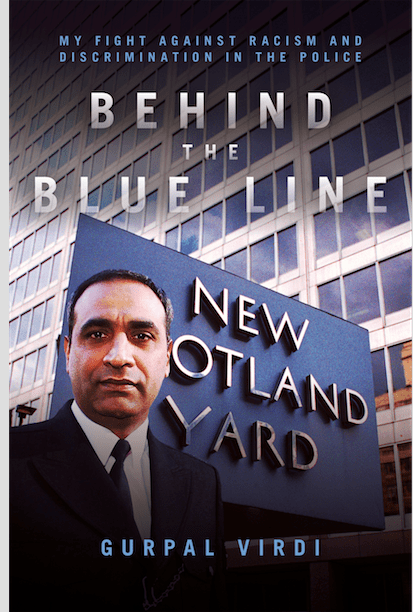
Image courtesy of Biteback Publishing

If ever you need a reference point on one man’s battle against institutional racism, then we recommend you get a copy of Gurpal Virdi’s book out today – Behind the Blue Line.

It is fair to say Virdi has been through it all. In 1998 as a police Sergeant in the MET he was falsely accused (and dismissed) for sending racist e-mails to himself, and other BAME officers and was subsequently exonerated. On his reinstatement to work, he says his career was essentially over because he’d spoken out and challenged racism in the police. However, what would have deterred a lesser man didn’t stop Virdi. He has successfully taken the MET to two industrial tribunals for discrimination, and bravely gave evidence to the Macpherson inquiry into the death of Stephen Lawrence – when he knew of the consequences. He is also the subject of the VIRDI inquiry report.

After his retirement, in 2014, he decided to enter local politics as a Labour candidate. Just before the election, he was falsely accused by the MET of a sexual offence against a minor and abandoned by many of his friends, so called colleagues and the Labour Party. He stood and won as an Independent. In 2015, a jury took 50 minutes to clear him of charges from an alleged incident in 1986. The presiding judge, His Honor Judge Andrew Goymer said a conspiracy may be behind the case. Despite his lengthy battles for justice and equality, Virdi remains a man who encompasses the Sikh ethos of chardi kala, or everlasting optimism.

We at the NSO have worked with Gurpal Virdi for many years and collaborated with him during his role at the Metropolitan Police Sikh Association (MPSA). Our Director, Lord Singh of Wimbledon was incensed at the allegations leveled against Virdi in 2014 and supported him during the trial.

We don’t often give book recommendations, but Gurpal’s journey in Behind the Blue Line is the rare exception as an injustice can happen to any one of us.