Where Unity Is Strength
Header

Author Archives: admin

http://www.ft.com/cms/s/2/137b1408-7dd9-11e3-95dd-00144feabdc0.html#axzz2qku6Ocwx

By Griselda Murray Brown and Kiran Stacey

The campaigner speaks out following revelation about UK government’s possible involvement in tragic incident
Lord Singh

Lord Singh is widely known for his contributions to the “Thought for the Day” slot on BBC Radio 4, urging religious tolerance in gentle, measured tones, but his influence extends far beyond the breakfast table. This tireless campaigner is currently demanding an apology from the British government over its possible involvement – revealed this week – in the 1984 attack by the Indian government on the Sikh temple at Amritsar.

A practising Sikh, Singh co-founded the Inter Faith Network for the UK in 1987 to promote better relations between religions, and in 2008 he became the first Sikh to address a major conference at the Vatican. He set up the Network of Sikh Organisations in 1995, co-ordinating pastoral care for Sikhs in hospitals, prisons and the armed forces. The Prince of Wales, Anglican bishops and the Metropolitan Police are among those who have consulted him, and he has advised the government on race relations. In 2011, he was made a crossbench life peer in the House of Lords – the first member to wear a turban.

Born Indarjit Singh in 1932 in Rawalpindi, now in Pakistan, he moved to the UK as a baby. Singh’s father, a doctor, had been involved in the Indian independence movement and was “virtually exiled” to east Africa; after studying in Britain he decided to move his family there rather than returning to India. So, in 1933, Singh, together with his two elder brothers and mother, joined his father in Birmingham.

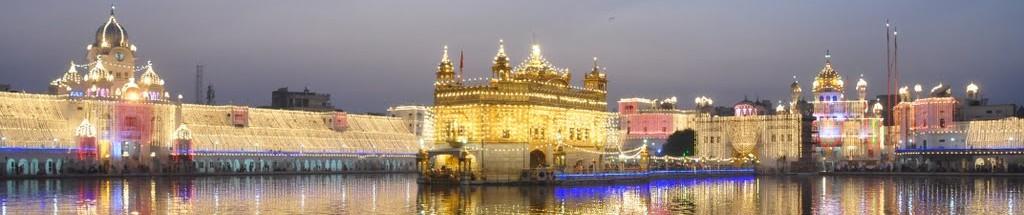
Singh now lives in the detached Victorian house in Wimbledon, southwest London, that he and his wife, Kanwaljit, bought in 1974. Forty years after the Singhs moved in with their two young daughters, the home feels lived-in but well-maintained, and various decorative objects attest to the couple’s broad tastes: an engraving of the Golden Temple in Amritsar, north India, the holiest Sikh shrine; an ancient Greek-style plate; a painted Alpine scene; and a Japanese print.

Singh met his wife in India, when he was working there as a mine engineer, and they moved to England in the mid-1960s – first to Birmingham, then London when Singh was offered a job in civil engineering. He later studied for an MBA and moved into local government. Kanwaljit, in turn, has worked as a primary schoolteacher, a headteacher and a school inspector. In 2011 she was awarded an OBE for services to education and interfaith understanding.

Wall hanging of the Golden Temple

Over tea and homemade samosas, Singh recalls his childhood in Birmingham – where, in 1939, the Indian population was estimated at just 100. “My parents had a very tough time. They wouldn’t give my father a hospital job so he set up his own practice as a GP. He was a very determined chap, but the patients didn’t come too quickly. My mother even had to pawn some of her jewellery for things like bread and milk.” At this, he breaks into laughter, his eyes almost disappearing as his face creases. “But they came through it all, and the practice grew and grew.”

Singh is serious in his beliefs but quick to laugh at life’s absurdities – even the absurdity of prejudice. The Singh brothers were the only non-white pupils at the local grammar school. “Everyone knew that Britain was top and everybody else was down there,” he gestures to the floor. “There was a history teacher who looked directly at me in class and said ‘They come over here, they get educated and they go back to India to harass us’.” Did that upset him? “No,” he says, “it was par for the course. We knew it was wrong but it was the game being played. It was snakes and ladders and your ladders had broken rungs.”

Indarjit Singh's dining room

After graduating from Birmingham university in 1959 with a first-class degree in engineering, Singh applied to the Coal Board to become a mine manager. However, at his interview he was squarely informed that “miners in this country wouldn’t like an Indian manager”. So he decided to leave home for India, a country he barely knew.

At that time, relations between Sikhs and Hindus in India were deteriorating. They had lived together harmoniously for centuries. But that changed with the Partition of India in 1947, when Pakistan was carved out as a Muslim land and bloodshed ensued as Hindus, Muslims and Sikhs found themselves on the wrong sides of the new borders. The Indian prime minister, Jawaharlal Nehru, had promised Sikhs “an area and a set-up in the north where in [they] may also experience the glow of freedom” – but no such provision was made. Sikhs felt increasingly marginalised and there was rioting in Punjab.

“When I went to India, Sikhs had no voice,” says Singh. “There was no Sikh press and if you wrote complainingly to the papers you were ignored. Being British, I thought ‘This is unfair, I’ve got to do something about it’.” A smile spreads slowly across his face. “If I wrote to the papers as a Sikh, there wasn’t a chance they’d print it, so I decided to write as my next-door neighbour in England, Victor Pendry, and my letter to the Hindustan Times was published. It had a huge ripple, especially in the Sikh community. My wife had heard about Victor Pendry before she met me.”

Mantelpiece at Indarjit Singh's home

At this point, Kanwaljit enters to refill our teacups. She is busy in the smaller back sitting room (she still works as a freelance school inspector), but she wants to check that we have everything we need. The couple’s grown-up children moved out years ago and the house feels big for two – big enough for a study each and several spare bedrooms. Initially, they made alterations to the place – “we knocked two rooms into one through-lounge, and built a kitchen extension and a garage” – but after a while they “got a bit lazy”. It seems likely they were less lazy than busy.

Singh co-founded the Inter Faith Network for the UK while still working full-time, and in 1989 he became the first non-Christian to be awarded the UK Templeton Prize “for the furtherance of spiritual and ethical understanding”. He wrote regularly for the Sikh Courier from 1967 and when, in 1983, its owner didn’t like Singh’s proposed articles on communal violence between Sikhs and Hindus in India, Singh left to establish a new publication, the Sikh Messenger, of which he remains editor.

Tensions with the Sikh community came to a head in June 1984 when India’s prime minister, Indira Gandhi, ordered the army to storm the Golden Temple complex and remove Sikh separatists, with co-ordinated raids on gurdwaras (Sikh places of worship). The attack fell on the anniversary of the martyrdom of Guru Arjan, founder of the Golden Temple, when thousands of pilgrims were gathered. Official estimates put civilian deaths at about 400, but independent reports claim thousands died. Four months later, Gandhi was assassinated by two Sikh bodyguards in an act of vengeance, and anti-Sikh rioting swept across India, killing thousands more.

Indarjit Singh's living room

It is now almost 30 years since the attack, an anniversary that has brought fresh information. A document released by the British government, under the 30-year rule, has revealed that Geoffrey Howe, the then foreign secretary, sent an SAS officer to India in the months before the attack to advise Gandhi’s government on its tactics.

The revelation has led David Cameron, the UK prime minister, to order an inquiry and the Foreign Office has accepted Singh’s offer of support. “I would like the authorities to take the opportunity to try and bring closure on something that is creating continuing suspicion between the Hindu and Sikh communities,” he says. “I want an open, international inquiry into those events – then you can punish those that are guilty on either side and give a sense of closure.”

For all his mild-mannered charm, Singh is not one to back down – and his drive is that of a much younger man. “It’s always worth having a say and keeping to your principles,” he insists. Three decades after the killings at the Golden Temple, he will be doing that more than ever.

——————————————-

Favourite thing

Singh’s house is full of awards: an OBE, a CBE, an honorary doctorate and countless tokens of appreciation from gurdwaras across Britain. But “the superior thing” is a painting by his granddaughter, which he has since framed. “I went to their house when her mum was away and I was deputed to do her plaits. She said ‘No one has ever done them quite like that’, and the next time I went there she presented me with it”.

Here is a link to an article in India Today on 14th January 2014

http://indiatoday.intoday.in/story/thatcher-colluded-with-indira-for-op-bluestar-labour-mp/1/336038.html

A British MP and a Sikh member of the House of Lords claimed that top secret documents suggested Prime Minister Margaret Thatcher’s government helped Indira Gandhi plan the storming of the Golden Temple in 1984 to flush out militants from the shrine, an operation that left more than 1,000 people dead.

Tom Watson, the Labour lawmaker from West Bromwich East, and Lord Indarjit Singh said the documents released under Britain’s 30-year rule included “papers from Mrs Thatcher authorising the SAS (Special Air Service) to collude with the Indian government on the planning on the raid of the Golden Temple”.

The government apparently “held back” some more documents and “I don’t think that’s going to wash”, he told BBC Asian Network.

“I think British Sikhs and all those concerned about human rights will want to know exactly the extent of Britain’s collusion with this period and this episode and will expect some answers from the Foreign Secretary,” Watson said.

He wrote on his website that he would write to the Foreign Secretary and raise the issue in the House of Commons to get a “full explanation”.

“But trying to hide what we did, not coming clean, I think would be a very grave error and I very much hope that the Foreign Secretary will…reveal the documents that exist and give us an explanation to the House of Commons and to the country about the role of Britain at that very difficult time for Sikhism and Sikhs,” he added.

On his website, Watson referred to documents that were made public by the organisation “Stop Deportations”. The organisation said these documents were among a series of letters released at the New Year by the National Archives in London.

A letter marked “top secret and personal” dated February 23, 1984, nearly four months before the incident in Amritsar, titled ‘Sikh Community’, reads: “The Indian authorities recently sought British advice over a plan to remove Sikh extremists from the Golden Temple in Amritsar.

“The Foreign Secretary decided to respond favourably to the Indian request and, with the Prime Minister’s agreement, an SAD [sic] officer has visited India and drawn up a plan which has been approved by Gandhi. The Foreign Secretary believes that the Indian Government may put the plan into operation shortly.”

Lord Singh, also the director of the Network of Sikh Organisations in the UK, now wants the UK government to reveal the extent of British government involvement in both Houses of Parliament

SAS involvement in 1984

January 22nd, 2014 | Posted by admin in 1984 Sikh Genocide | Press Releases - (0 Comments)

London: (13th of Jan 2014) The Network of Sikh Organisations (NSO) can confirm that the Foreign and Commonwealth Office (FCO) has been in contact with Lord Singh, further to a leak of documents, indicating Thatcher’s approval of SAS collusion with the Indian government’s attack on the Golden Temple in 1984.

The Prime Minister, David Cameron has ordered an inquiry into the then governments involvement.

The FCO have readily accepted the offer of support from Lord Singh to support any investigation.

[Ends}


Notes to Editors.

1.      The Network of Sikh Organisations (NSO) is a registered charity that links more than 100 Gurdwaras and other UK Sikh organisations in active cooperation to enhance the image and understanding of Sikhism in the UK.

Hardeep Singh

Press Secretary

The Network of Sikh Organisations

http://www.nsouk.co.uk/

London: (17th of Jan 2014) Leading academics and local residents join Lord Singh Director NSO, to urge Mr. Nawaz Sharif the Pakistani Prime Minister, to help preserve a historic gurdwara in Wazirabad, Gujranwala District. The gurdwara known as Guru Kotha, was named after Guru Hargobind Ji, the sixth Guru of the Sikhs. Nadir Cheema, from The School of Oriental and African Studies (SOAS) approached Lord Singh of Wimbledon, the NSO’s Director for support.

In an open letter to Pakistan’s Prime Minister the signatories write:

“It should be a matter of pride for you, as the Prime Minister of Pakistan, that the Muslim residents of Wazirabad, listed in this letter, were the first to show their concern about the state of the gurdwara and brought this to our attention. In the last ten years around 200 mosques have been restored in Indian Punjab with the help of Sikh and Hindu communities. Showing such a measure of mutual respect for each other’s religious sentiments could play a huge part in producing sustainable peace and coexistence between two nations.”

Nadir Cheema from SOAS said, ”I approached Lord Indarjit Singh on behalf of Muslim residents of Wazirabad, Gujranwala District (Pakistani Punjab). The residents had been trying to preserve the gurdwara in the city of Wazirabad, which is illegally occupied and incessantly encroached. The gurdwara was named after Guru Hargobind Ji, the sixth of Sikh Gurus. Lord Singh encouraged me to take the matter up with higher authorities; he supported and guided me at every step. He directly wrote a letter to the High Commissioner of Pakistan and is the main signatory of the letter to the Prime Minister of Pakistan, which is also supported by senior Sikh academics at British universities.”

He added “The High Commissioner of Pakistan in London has assured me that he will forward the letter to the Prime Minister of Pakistan with his strongest recommendation for the preservation of the historic gurdwara in Wazirabad. We, the residents of Wazirabad, are highly indebted to Lord Singh for his support. Such endeavours will help us to revive the plural culture of Punjab which transcended religious boundaries for centuries.”

[Ends]

Notes to Editors.

1.      The Network of Sikh Organisations (NSO) is a registered charity that links more than 100 Gurdwaras and other UK Sikh organisations in active cooperation to enhance the image and understanding of Sikhism in the UK. 

Hardeep Singh

Press Secretary

The Network of Sikh Organisations

Welcome

JOINT STATEMENT BY THE NETWORK OF SIKH ORGANISATIONS,THE HINDU COUNCIL(UK) & THE SIKH MEDIA MONITORING GROUP(UK)

PRESS RELEASE

UK Sikh and Hindu organisations condemn recent comments by MP on sexual grooming in Rochdale and denials by the local Police force on the pattern of abuse.

London: (18th of December 2013) The Network of Sikh Organisations,The Hindu Council UK and The Sikh Media Monitoring Group (UK) jointly condemn recent comments by Labour Rochdale MP Simon Danczuk that certain ‘Asian’ communities are in denial after a spate of sexual grooming cases in Rochdale and also condemn Greater Manchester Police’s denial of an obvious pattern of abuse.

Joint groups of Sikh and Hindu organisations in recent years have campaigned against the use of the blanket term ‘Asian’ when reporting on several high profile court cases recently involving sex grooming gangs of mainly Pakistani origin – which many felt unfairly smeared Britain’s Sikhs and Hindus (see below link):

http://www.bbc.co.uk/news/uk-18092605

These same gangs have also targeted Sikh and Hindu girls in the UK and this was the subject of a recent BBC documentary (see below link):

http://www.youtube.com/watch?v=7hXTM7ehvtk

Mr Danczuk’s failure in highlighting that it was gangs from the Pakistani-Muslim community that were responsible for such abuse must be condemned in light of the fact that no Sikhs and Hindus were ever involved. This has caused outrage within the UK’s Sikh and Hindu communities, many of whom interpret this as either political correctness or incompetence and has led to an online petition to be set up in protest (PLEASE SIGN PETITION):  

http://www.ipetitions.com/petition/we-the-undersigned-demand-that-politicians

Equally as disappointing was the denial by Greater Manchester Police of a pattern of abuse of white girls being targeted by local Pakistani-Muslim gangs – despite similar patterns emerging after high – profile convictions in several UK towns and cities in recent years.

We welcome the forthcoming inquiry in the New Year chaired by Labour Stockport MP Ann Coffey to assess improvements in protecting young people since the Rochdale case. However, we feel it will be doomed to failure if high profile figures are either inaccurate or in denial in recognising the root causes of an undeniable pattern of sexual abuse emerging throughout the country.

The Network Of Sikh Organisations

http://nsouk.co.uk/

The Hindu Council UK

http://www.hinducounciluk.org/

The Sikh Media Monitoring Group (UK)

Appendices:

http://www.telegraph.co.uk/news/uknews/crime/10507023/Asian-communities-in-denial-about-grooming-says-Rochdale-MP.html

http://www.manchestereveningnews.co.uk/news/local-news/mp-rochdale-simon-danczuk-made-6402120

For more information please contact:

 Mr Ashish Joshi

Sikh Media Monitoring Group (UK)

Tel:07917 633186

http://www.ipetitions.com/petition/we-the-undersigned-demand-that-politicians

Earlier this month (Dec 2013) on BBC Radio 4’s World at One, Simon Danczuk MP for Rochdale said there was “no doubt” ethnicity was a factor in grooming cases. He said “We still need a breakthrough, I think, in terms of the Asian community” Simon Danczuk’s use of the term ‘Asian’ in this context is grossly insulting to the Hindu and Sikh communities.

Those convicted in Simon Danczuk’s constituency for grooming of white British girls in May 2012, included 8 men of Pakistani origin and one from Afghanistan. Judge Gerald Clifton who sentenced the men said they treated the girls as though they were worthless and beyond respect” he added “One of the factors leading to that was the fact that they were not part of your community or religion”

The men were of predominantly Pakistani Muslim origin.

As in Simon Danczuk’s example, by masking the identity of perpetrators by using vague terminology ‘Asian’, we are unable to have a mature discussion or get to the root cause of an emerging pattern of criminality. This is important because…..

· Use of the word ‘Asian’ is unfair to Sikhs, Hindus and other communities who are of Asian origin and have not been involved in the emerging pattern of convictions for sexual grooming.

· 1.1 The reported convictions of men for sexual grooming of white British girls, almost always involve men of Pakistani origin.

· 1.2 There is reluctance by both government and media to discuss the disproportionate representation of Muslims in such cases.

· 1.3 Victims are almost always non-Muslim girls

· 1.4 The Hindu and Sikh communities have been complaining about targeting of their girls by Muslim men for decades

· 1.5 In August 2013, Muslim men were amongst those convicted for the sex grooming of a Sikh girl in Leicester.

· 1.6 Communities who themselves fall victim of this emerging pattern of criminality, should not be besmirched by the vague terminology ‘Asian’.

· 1.7 In order to help find a solution to the problem, we need to be clear on the identity of those involved. We will not be able to do this if we mask the identity based on misguided views of protecting a vulnerable community of perpetrators and not looking at the vulnerable community of victims.

· 1.8 Political correctness by some of our elected representatives is stifling an important debate.

· 1.9 We believe that in this case the government itself is sanctioning the use of term Asian as a way of clouding responsibility.

http://www.ipetitions.com/petition/we-the-undersigned-demand-that-politicians

The Network of Sikh Organisations

Welcome

Sikh Media Monitoring Group

Hindu Council UK

www.HinduCouncilUK.org

London: (17thof Dec 2013) In a debate last week led by Lord Dubs, Peers gave their views on plans to change laws in favor of “assisted dying”. The Assisted Dying Bill was tabled by Lord Falconer, it had it’s first reading earlier this year, it will go to a second reading in 2014. The Director of the Network of Sikh Organisations (NSO), Lord Singh of Wimbledon added a Sikh perspective to last weeks debate, stressing the importance to ‘accept that life is a gift from god’ whilst highlighting the ‘Sikh teachings of compassion, dignity and care for the suffering’. Please see full text of speech:

My Lords, this debate takes us into new ethical territory with complex medical, legal and emotional implications. Rational discussion is made more difficult by a polarisation of attitudes and opinions. I saw something of this about 12 months ago when I attended a meeting of the All-Party Parliamentary Group on Assisted Dying. I raised some concerns and was made to feel that there was something wrong with my thinking if I could not immediately see the open-and-shut case for changing the existing law. I am also too aware of the opposite arguments, couched in religious terms, that life is a gift from God and we should never, ever, even think of curtailing it.

I served for some years as a member of the BMA Medical Ethics Committee and am well aware of major changes in society and bewildering advances in science and medicine that require us to constantly look anew at previously accepted views and attitudes. Sikhs accept that life is a gift of God to be cherished and preserved wherever possible, but we are also required to bear in mind the important Sikh teaching of compassion, dignity and care for the suffering. These two considerations are not necessarily incompatible. However, I am unhappy about a narrow focusing on individual autonomy to justify attitudes that clearly affect others. We have seen some of this today. We constantly hear the argument that we are all individuals and that our happiness and needs are all-important to the exclusion of our responsibility to others. I believe that this over-focusing on self, on me and my, is responsible for many of the ills in society today. For example, we are all aware that religious teachings suggest that marriage is a committed partnership for mutual care and support and for ensuring that children grow up as responsible adults.

What I believe to be a short-sighted contemporary social attitude encourages us to believe that it is okay to look exclusively at our rights, without consideration of the effect on others. This focusing on individual needs rather than on the family as a whole is, at least in part, responsible for the growing increase in dysfunctional families, with children frequently ending up in what we euphemistically call care, or with them mirroring the narrow thinking of their parents. A person’s decision to end their own life has an effect on friends and, importantly, on the message it can give to wider society of trivialising life. We all have wider responsibilities in all that we do.

I shall pull together these different threads in rational and compassionate decision-making to arrive at the way forward. First, we should always respect the gift of life and question the concept of autonomy. Secondly, there are times when those in ill health feel that life is not really worth living but, within a short time, they often feel that it is not really that bad. It is worse for those who find themselves with severe disabilities but, as the Paralympics showed, despite such disabilities, it is often possible to live a meaningful life. Relatives and carers sometimes find looking after someone onerous, and they can inadvertently make their feelings known to those they are caring for, making them feel an unnecessary burden. Sadly, there are others who may have more mercenary motives. A seemingly hopeless situation today may not always remain so. Huge strides are constantly being made in combating previously incurable diseases, as well as in palliative care.

In summary, while we should always be on our guard against the notion of individual autonomy trivialising life, we need to recognise that, from an individual’s perspective, life can become pretty intolerable and there is an argument for helping to end it in strictly controlled circumstances. The danger is that, if we go down this path, it could itself be a slippery slope to trivialising life, altering the very ethos on which medical care is provided. I feel, on balance, that we should leave the law as it is.

Baroness Morris of Bolton, Lord Taverne, Lord Alton of Liverpool, Baroness Warnock and Baroness Hayman and other Peers contributed to the controversial debate. Last month, three of Britain’s most senior legal authorities including Baroness Butler-Sloss, said relaxing the law on assisted suicide would amount to asking Parliament to write a “blank cheque” for euthanasia.

Notes to Editors.
 
1.      The Network of Sikh Organisations (NSO) is a registered charity that links more than 100 Gurdwaras and other UK Sikh organisations in active cooperation to enhance the image and understanding of Sikhism in the UK.
Hardeep Singh
Press Secretary
The Network of Sikh Organisations

London: (07thof Dec 2013) The Network of Sikh Organisations (NSO) has written to the Holocaust Memorial Day Trust (HMDT) suggesting the inclusion of both the Sikh (1984) and Tamil (2009) genocides, on Holocaust Memorial Day (HMD) on the 27th of January 2014.

In an unprecedented move the NSO wrote:

‘The list of major atrocities following the Holocaust against the Jewish people is rather selective Notable omissions are the organised mass killing of more than 100,000 Sikhs throughout India in 1984 and the more recent killing of more than 40,000 Tamils by government forces in Sri Lanka.

It’s important that we are seen to be even-handed in reminding ourselves that even those with whom we have trade and political links can carry genocide out anywhere.

The 27th of January marks the liberation of the largest Nazi concentration camp, Auschwitz-Birkenau. The millions of people killed by the Nazi’s and the subsequent genocides in Cambodia, Rwanda, Bosnia and Darfur will be remembered, whilst survivors of these hate filled regimes honored.

The NSO earnestly hopes the list will be amended in future years, adding both Sikh and Tamil genocides.

Hardeep Singh
Press Secretary
The Network of Sikh Organisations

London: (1st of Dec 2013) Lord Singh the Director of the Network of Sikh Organisations (NSO) was invited to give a talk on the founder of Sikhism, Guru Nanak at the High Commission of India earlier this week. In his speech and notably his first visit to the Indian High Commission since 1984, Lord Singh reminds the Indian Government about the carnage of 1984, calling for a Truth and Reconciliation Commission. Please see full text of speech:

Your Excellency, Friends.

It’s a real pleasure to be given this opportunity to talk about the life of Guru Nanak, an enlightened a visionary whose teachings offer uplifting guidance to all of us today, in the UK, India and the wider world.

Guru Nanak, who lived in the 15th century was deeply concerned that people at the time were ignoring the many ethical teachings our different religions hold in common, and instead focussing on supposed differences and divisions. It was against this background that the Guru in his very first sermon said

‘Na koi Hindu na koi Mussalman’; that is in God’s eyes there is neither Hindu nor Muslim, and by today’s extension, neither Christian, Sikh nor Jew. That the one God of us all is not interested in our different religious labels but in what we do to bring peace, justice and harmony to our fellow beings.

Guru Nanak travelled widely, with a Hindu and a Muslim companion, emphasising common ethical imperatives in our different faiths, while criticising superstition and divisive practices that attach themselves to, and take us away from true teachings of responsible living and care for our fellow beings.

More than 500 years ago, he emphasise the complete equality of all human beings, laying great stress to the dignity and full equality of women; something still not accepted by many societies today. The Guru repeatedly taught the importance of respect for all beliefs.  One of Guru Nanak’s successors, Guru Arjan, our 5th Guru underlined this respect for other faiths by inviting a Muslim saint Mia Mir to lay the foundation stone of the Darbar Sahib or Golden Temple. He also included verses of other faiths which parallel Sikh teachings in our holy scriptures the Guru Granth Sahib. The following lines by the Muslim poet Kabir for example, resonates with Sikh teachings on equality. Kabir writes:‘

The same one Divine light permeates all Creation. Why should we then divide people into the High and the low?

Guru Nanak reminded us and society today needs reminding, of the importance of responsible and balanced living. He taught that we should always live by three golden rules. These are Naam japna or reflecting on ethical teachings of right wrong and responsibility to give us a focus on daily living, kirt karna or earning by honest effort and thirdly and most importantly, wand chakhna or sharing with others, not only earnings, but also, increasingly important today, out time to help others. This Seva or looking to others is a common feature of our different religious teachings.

Guru Nanak’s teachings were widely welcomed by all communities and when he died, it was said of him:

Nanak Shah Fakir

Hindu ka Guru ; Mussalman ka Pir.

That is, he was regarded as a great religious leader by both Hindus and Muslims.

Guru Nanak’s never claimed any unique relationship with God or a monopoly of truth. He welcomed and rejoiced in parallel insights into the same truths, found in different religions, constantly stressing respect for our different faiths, and reminding us that we all need to work together, focussing on ethical values of right, wrong and responsibility in our common quest for a fairer and more peaceful society.

Friends, Sikhs perhaps more than others love celebrating important days in our history, but such celebrations are of little use unless we use them to re-charge our spiritual and moral batteries to help us live true to the values and truths we celebrate.

As we celebrate this year’s anniversary of Guru Nanak’s birth, it is important to remember that a central thrust of his teachings was to promote love and understanding between different religions. It therefore pains me to see how since partition, Hindus and Sikhs have grown apart from the days when our communities were so close that many Hindu parents would bring one of their children up as a Sikh.  Sadly the two communities grew further apart following the attack on the Golden Temple and the widespread killing of Sikhs throughout India in 1984.

Friends, next year sees the 30th anniversary of that terrible period in our recent history. I will be frank. My fear is some in the Sikh community, and others in the wider community, will use the anniversary to perpetuate anger and suspicion. This will not help anyone. My hope is that all in positions of political or religious power take the wind out of the sails of such people, by openly and objectively looking at and learning from the lessons of the past in building bridges of love and understanding between followers of our sister faiths as taught by Guru Nanak.

My plea is that next year’s anniversary be seen as an opportunity to establish some sort of Truth and Reconciliation Commission that brings to justice those responsible for criminal behaviour on either side, while at the same time, highlighting the much larger, largely unrecognised role of those who stood up bravely against the killings, sheltering and shielding Sikh neighbours. I firmly believe that a long overdue initiative on these lines will heal wounds, bring closure and make incredible India even more incredible. I will be happy to elaborate on anything I’ve said. Thank you for listening to me.

[Ends]

Notes to Editors.

1.      The Network of Sikh Organisations (NSO) is a registered charity that links more than 100 Gurdwaras and other UK Sikh organisations in active cooperation to enhance the image and understanding of Sikhism in the UK.

Hardeep Singh

Press Secretary

The Network of Sikh Organisations

THOUGHT FOR THE DAY – 06/11/13

November 30th, 2013 | Posted by admin in Thought for the day - (0 Comments)

Over the last few days Sikhs have been celebrating the festival of Bandi Chhor, lierally the ‘release of captives’. Bandi Chhor coincides with the Hindu festival of Diwali and is linked to an incident in the reign of the Mughal Emperor Janghir who lived in the early 17th century.

By all accounts Janghir was both intolerant and cruel. Even before he became Emperor, he tried to seize the throne from his tolerant and popular father Akbar. Janghir, wary of those who might oppose his rule, arrested the sixth Guru of the Sikhs, Guru Hargobind, and a number of others and imprisoned them in Gwalior Fort.

But even the worst of us likes to be liked, and as the festival of Diwali approached he ordered the release of Guru Hargobind. To his surprise, the Guru refused to leave unless all other political prisoners were released at the same time.

Janghir decided to compromise and said that anyone who could hold onto the Gurus clothes could also go with him. He thought that at the most, two or three of his fellow prisoners would be able to go with the Guru through the fort’s narrow passage to freedom. In the event the Guru walked to freedom followed by all the 52 political prisoners holding onto tassels of varying length that had been sewn onto the Guru’s cloak. He reached Amritsar just as people were celebrating Diwali which Sikhs, like Hindus now celebrate with lights and fireworks.

The story reminds Sikhs to put the wellbeing of others before our own; in this case the freedom and human rights of the Guru’s fellow captives. This concern for others is echoed in another story of a Sikh water carrier who was dragged before the 10th Guru of the Sikhs, Guru Gobind Singh, accused of supplying water to enemy wounded. The Guru asked him what he had to say for himself, and water carrier replied that he saw neither enemy nor friend but suffering fellow beings. The Guru applauded his reply and gave him ointment and bandages to further his humanitarian work; work that we see today in the activities of many religious and secular humanitarian organisations, who often in great danger to their own lives, work to help others. Bandi Chhor is a useful reminder to the rest of us to make concern for others part of our daily lives.