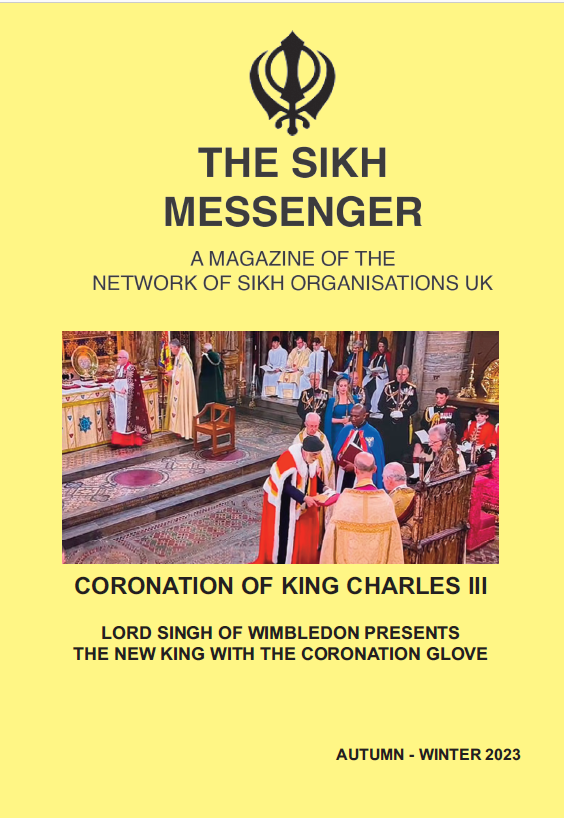
download below:

Sikhs In Law is a group of self-selected lawyers with no longstanding record of involvement in the affairs of the Sikh community, or legal standing in the judiciary. Despite a lack of knowledge of the Sikh religion, and religion more generally, it appointed a ‘Select Committee’ to look at the Bloom Review and report its findings at a meeting in the House of Lords on 19 July 2023.
The group, seemingly obsessed with its own self-importance, referred to itself as ‘The Honourable Council’, and absurdly asked those present in the room to stand as they entered the room, as if they were judges in a court of law.
The presentation that followed was deeply disappointing and at times embarrassing. We had been led to believe that we would be presented with an objective analysis of the Bloom Review. But no, Bloom was in the dock. Here is a flavour of what the attorney for the prosecution had to say:
Comment – It is difficult to believe that members of this ‘Select Committee’ (comprising of Sikhs) know so little of Sikh teachings. Verses of Muslim saints are included in the Guru Granth Sahib to illustrate similar truths between faiths.
Moving away from the above examples of bias and ignorance, (there are many more), let us look at excuses made for what Bloom rightly describes unjustifiable behaviour that brings the community into disrepute.
Network of Sikh Organisations
(NSO Comments in italics)
Bloom: ‘The British Sikh community is one of the oldest minority communities in the UK, but the first major immigration of Sikhs to the UK was in the 1950s. Many settled in London and the West Midlands, and by most measurements British Sikhs have successfully integrated into communities across the whole of the UK. According to the 2021 Census results, there are approximately 524,000 people in England and Wales who identify as Sikh.’
Data included in Bloom shows that British Sikhs have:
Bloom’s ‘areas of concern’
‘The first area of concern is the power struggle within some areas of British Sikh communities over who will represent them at official levels and be recognised as the preeminent Sikh body in the UK. Government should take a pluralistic approach to engagement, and the COVID-19 Sikh roundtable set up in May 2020 is a good example of how this can be done. The approach also avoids ‘gatekeeping’, which limits government’s capacity to engage a particular faith in all its diversity and diminishes its integration within wider society.’
| NSO Comment Yes, but groups invited should have some tangible record of contribution to society and social integration. The report warns against self-proclaimed representatives who bring the community into disrepute. |
The second concern
‘The division between some British Sikh communities which is caused by an extremist fringe ideology within the pro-Khalistan movement, a separatist movement seeking to create a sovereign homeland for Sikhs in the Punjab region. It is important to note that the promotion of Khalistan ideals is not itself subversive, but the subversive, aggressive and sectarian actions of some pro-Khalistan activists and the subsequent negative effect on wider Sikh communities should not be tolerated.’
| NSO Comment Only a very small minority of Sikhs are involved, but unfortunately, they cause disproportionate disruption. Gurdwara Management Committees should be alert to such groups seeking power and funds for negative activities. |
Third Concern
‘The third area of concern is the activities of some individuals and organisations that are demonstrably fuelling sectarianism and anti-Muslim sentiments, as well as legitimising discriminatory and misogynistic behaviour.’
NSO Comment The report ignores the fact that anti-Muslim sentiments generally result as a reaction to the behaviour of Muslim grooming gangs towards Sikh girls, and other non-Muslim girls. Misogyny exists in all communities, but is less in Sikhs, because of Sikh teachings on gender equality, which are followed by the majority. |
Quote from anonymous participant in Bloom: ‘Only minority Sikhs are causing divisions and hate, [the] majority are peace loving but these minority are controlling the leading Sikhs temples in England and using funds raised for worship for propagating Khalistan and openly do that on social media. All are allowed to express their views and raise concerns of any injustice in India but spreading hate and brainwashing Sikh youth is a matter of serious concerns and many Sikh Temples are allowing [organisations to have youth camps where some are trying to recruit youth to follow their hate, terror and division agenda.’
Bloom concludes: ‘Although these three areas of concern are different, they are sometimes conflated by self-appointed ‘community leaders’ seeking prestige or power.’
| NSO Comment The statement is essentially correct and a cause for concern, but the use of words like ‘hate’ and ‘terror’ agenda, are a little over the top in describing this undemocratic seeking of power and authority. (although we understand why the respondent chose to be anonymous, for fear of backlash). |
Bloom says, ‘numerous respondents were deeply concerned about the division and distress caused by some activist groups aggravating communities and painting an unduly belligerent picture of the Sikh faith. These groups can associate themselves with mainstream Sikh communities, but their intimidatory and subversive methods are considered by most to be alien to the basic tenets of the Sikh faith. Respondents warned that if government doesn’t distinguish extremist agendas of power, control and subversion from mainstream Sikh communities, it would result in the UK turning a “blind eye towards religious extremism. This review’s evidence gathering also found repeated cases of individuals being intimidated and threatened by aggressive Sikh activists, either directly or indirectly through family members, for openly standing against them. The difficulty in Sikhs speaking out has been previously noted. In the 2019 report for the Commission for Countering Extremism, ‘The changing nature of activism among Sikhs in the UK today’, some potential respondents reportedly refused to participate because they feared backlash and others chose anonymity. It is important to note that Sikh identity and outlooks can be defined by historic events.’
He goes on: ‘Any study of Sikh activism today must take account of the Sikh historical context, including in relation to persecution and survival. This context can evoke powerful emotions of injustice and duty which can be used to lend relevance and legitimacy to actions. Any investigation into aggressive Sikh activism or extremist behaviour must therefore seek to understand the historical and philosophical root causes, while firmly setting parameters for what is and is not acceptable activity or behaviour in the pursuit or promotion of ideals. This reviewer urges government to consider the proposed recommendations with this in mind.’
Who represents British Sikh communities?
Bloom says, ‘for the government to engage with British Sikh communities in both a constructive and productive way, it is vital to address the issue of who is best placed to represent British Sikhs. This issue was raised repeatedly in written comments throughout the call for evidence, with many Sikhs concerned that the genuine interests of their communities are at risk of being overlooked due to public officials’ insufficient understanding of intrafaith dynamics.
The structure of Sikh communities in Britain differs significantly from some other religions because there is no official leader or religious authority for Sikhs in the UK. Instead, there is a plurality of councils, communities and groups. This complexity can create a power struggle over who will be the pre-eminent Sikh body at official levels, in government bodies.
These tensions can play out publicly, but they are not always clear to the average observer. As part of the evidence gathering for this report, politicians, public figures, academics and officials provided evidence, some of whom are high profile. Because of their fear of retribution, they spoke under the condition of anonymity, but their stories were all very similar. At times they have felt disparaged, victimised, harassed or threatened by aggressive Sikh activists who do not hesitate to abuse or bully anyone who either criticises them or does not follow or support their opinion. Many have been intimidated and called ‘traitors’, ‘impure’, ‘nastic’ (infidel) and ‘patits’ (heretics).
Members of different political parties who have served in public office have given examples of how they felt pressured to do what these activists wanted, and how some Sikh activists claim to have power over not only the ballot box, but also the selection processes of different local parliamentary and political bodies. One public servant said they would “live in fear” of retribution if they were to speak out against the ideological narrative of the activists. Others have confirmed that investigations into this type of extremist behaviour, which this report aims to present, are long overdue.
The government must take special care in understanding and wisely navigating these aspects of Sikh communities. Through improved faith literacy training for public servants, outlined in recommendation 4 of this report, government and the Civil Service will be able to more effectively discern between those who can genuinely represent the Sikh faith and those who are exploiting theSikh faith as a vehicle to promote divisive interests which fracture communities at home and abroad.’
Pro-Khalistan subversion
Bloom writes, ‘The Khalistan movement is a Sikh separatist movement seeking to establish an independent and sovereign Sikh state called Khalistan (Land of the Pure) in the Punjab region of India. The movement grew in power and influence in the 1980s and 1990s. Many acts of violence and extremism occurred in the aftermath of Operation Blue Star, which remains a highly emotive issue for many Sikhs.’
| NSO Comment The report should have put the idea of Khalistan in context. Operation Bluestar was an attack on the Golden Temple by the Indian army on one of the holiest times in the Sikh Calendar, designed to humiliate Sikhs. Thousands of Sikhs were killed or tortured to death. It was followed later in the year by the government supported genocide of Sikhs throughout India with the burning of Sikh homes, the torture and burning alive of Sikh men and the rape of Sikh women. The revulsion to the government backed genocide in which the Indian Army declared that all practising Sikhs were legitimate targets, was, if Sikhs are treated in this way, we’ll seek a separate homeland. The reality however is that Sikh teachings which emphasise the equal rights of all communities, do not support the idea of a Sikh religious state where Sikhs have more rights than other communities. This hasn’t stopped disreputable elements in the Sikh community exploiting the still lingering sense of hurt for their own selfish ends. |
Bloom continues: ‘There is a small, extremely vocal and aggressive minority of British Sikhs who can be described as pro-Khalistan extremists. This reviewer is of the opinion that every individual has the right to protest both here and abroad and values the importance of doing so within a democratic state. The promotion of pro-Khalistan ideas does not have to be subversive. There are many democratic avenues for political persuasion which do not involve manipulative threats or intimidation. However, this reviewer is deeply critical of any group which uses physical, psychological or political coercion and abuse to further its interests. While these extremists reflect a tiny minority, they attract disproportionate amounts of attention and stoke divisive sentiments in sectors of Sikh communities. This reviewer heard views that some of these groups or individuals have sought to artificially inflate their influence and legitimise dubious positions or tactics by using the ‘Sikh’ label to lobby political bodies. By circumventing democratic order, some groups compete for power by masquerading as human rights activists, presenting a false appearance of legitimacy. The use of various aliases which attempt to divert public attention away from a central umbrella organisation is a common strategy used to subvert the British political order.’
The issue of secessionist political agendas
Bloom adds: ‘Subversive activity in the UK agendas within the Indian diaspora was highlighted during the controversy over calls for an additional tick box option in the 2021 Census. The Office for National Statistics concluded that including ‘Sikh’ under ‘Other ethnic groups’ prompted concerns and suspicions about why Sikh was being separated from the Asian or Indian tick boxes, as the majority of those answering ‘Sikh’ to the religion question in the 2011 Census and the 2017 ethnic group question test ticked the ‘Indian’ ethnic group box. This was still the case when a Sikh tick box was added to the ethnic group question in testing. Attempts to change the Census have come from members of Sikh communities, but they are not reflective of the whole faith community.
Some respondents to this review claimed that the tick-box controversy bears all the traits of an extremist interpretation of pro-Khalistan ideology and has no relation to the ancient Sikh teachings of oneness, which they said contains no endorsement of an exclusive ethno-religious state called Khalistan.
Whether or not this is the case, government must have the clarity and confidence to ensure neither the Census nor the British political system become entangled in divisive or subversive agendas.
A prominent Sikh in public life, Lord Singh of Wimbledon, has also alleged deliberate ill-treatment aimed at silencing him in his recent evidence to the House of Lords Conduct Committee. He was responding to a complaint against him brought by Preet Gill MP to the House of Lords Committee on Standards’.
| NSO Comment Preet Gill MP, a prominent Sikh Federation UK (SFUK) supporter irked by Lord Singh’s contention that Sikhism was a world religion not tied to a part of Punjab, took out a vindictive complaint against him with the Parliamentary Commissioner for Standards. In it, she claimed Lord Singh was rude to her in front of an ONS official. This was totally denied by the official in evidence, and the case was thrown out. |
Bloom writes: ‘It is difficult to prove given the complex structures and multiple aliases of various groups, but conversations with academics and political figures have given this reviewer grounds to suspect that there is at least overlap of membership between some Sikh groups operating in the UK and proscribed (or previously proscribed) groups.
In particular, this report recommends that the MPs who are in the All-Party Parliamentary Group for British Sikhs consider the findings of this report. The parliamentary authorities must do what they can to ensure that the parliamentary estate is not unwittingly hosting organisations and individuals who have been linked to bullying and harassment at best, and subversive behaviours at worst, which are antithetic to the parliamentary estate’s own values of truth, justice, peace, tolerance and democracy.’
| NSO Comment This is an important recommendation which requires urgent action. The APPG under the chairmanship of Sikh Federation UK (SFUK) supporter Preet Gill MP, stifled hearing of opposition voices or an open discussion with MPs on the APPG on issues like the SFUK’s ‘Sikh’ tick box Census, which might question SFUK’s stance. The narrow focus of the SFUK on the pursuit of political power led to the APPG’s Chair and secretariat’s failure to consider the implications of the Offensive Weapons Bill (p51 of the report) on the Sikh cultural practice of presenting a full-length kirpan to an individual for making a significant contribution to the Sikh community. Nor did the Sikh Chair of the APPG pick up the omission in Parliamentary debate. When the Bill moved to the Lords, Lord Singh of Wimbledon tabled an amendment which won the support of all parties to the annoyance of SFUK who lobbied a government minister to state in debate on the Bill that she had been fully briefed by SFUK. The implication was that she believed that this fringe body which failed to understand the implications of the Offensive Weapons Bill spoke for the wider Sikh community (At a conference in Estonia, Lord Singh, who suggested the amendment, was introduced by the then British Ambassador, as ‘the man who brought Guru Nanak to the breakfast tables of Britain’). |
Bloom says, ‘The right to hold certain beliefs should always be upheld, as should the right to freedom of expression of those beliefs. But government must take extra care to ensure that the beliefs and subsequent behaviours of individuals or organisations do not conflict with or undermine democratic order.
Government must allow for the proper level of engagement with British Sikh communities, but it must also impede the advance of subversive groups which attempt to fracture majority Sikh communities and negatively affect the stability of our society. It is important that government neither overlooks nor fails to be discerning when it comes to concerns regarding extremist ties when selecting the individuals and groups responsible for representing British Sikhs at official and political levels.’
Sectarian or discriminatory behaviour in the UK
Sikh-only marriages.
On Sikh marriages, he says ‘For generations, many Sikhs have been able to marry outside the community, including interfaith marriages, without any problems. However, some groups have sought to aggressively pressure Sikh leaders and gurdwaras to ban the use of the Anand Karaj (the Sikh marriage ceremony) for interfaith marriages. In 2007, arsonists attacked the house of a gurdwara leader in Birmingham in what was believed to be a reprisal attack for allowing a mixed marriage (despite the fact that the gurdwara claimed the man voluntarily chose to convert ahead of the wedding). During an interfaith marriage at the Leamington Spa gurdwara, a group of more than 50 men protested against the marriage. Those present at the gurdwara subsequently complained of the protestors’ very aggressive language and behaviour.’
| NSO Comment A church marriage can only be between Christians and marriage in a Mosque between Muslims. Similarly, marriage in a gurdwara should be between those with a commitment to Sikh teachings. The Anand Karaj marriage ceremony in a gurdwara is a public commitment by both partners to live true to Sikh teachings, pledging mutual support in service to the wider community. A marriage in a gurdwara where one, or both parties have no intention of living true to the requirements of the Anand Karaj is hypocrisy bringing the gurdwara into disrepute. Unfortunately, some gurdwaras, turn a blind eye to such a charade in pursuit of additional income. While violence and unruly behaviour is to be deplored, gurdwara congregations should do more to hold management to account. Sikh teachings have nothing against an interfaith marriage where one partner is a non-Sikh, but this should take place in a registry office. If the bride or groom wish it for family reasons, a reception could follow in the langar hall, or the bride and groom could opt to receive a blessing from a granthi (priest). |
Bloom continues, ‘Several Sikhs have previously alleged that advocacy against grooming is being used as a guise to promote anti-Muslim hatred. Some members of the Sikh community have expressed concerns that others are focusing on the reported grievance of Muslim men grooming or sexually exploiting Sikh women, sometimes with the intention of converting them, to the exclusion of other types of intra-community abuse which they worry may be going ignored.
Furthermore, a small minority of individuals connected to certain Sikh groups appear to have had historical associations with white nationalist groups such as the English Defence League and the British National Party (despite protestations to the contrary). These are likely to have centred around a common anti-Muslim agenda, including on tackling alleged Muslim grooming gangs.
Online and media content Sikh extremists and their supporters often upload videos and other materials onto social media platforms such as Facebook, iTunes and YouTube which contain alarmingly dangerous and offensive imagery, language and the glorification of extremist behaviour. There are videos that incite violence and hatred towards Muslims, Hindus and even other Sikhs who disagree with the minority extremist ideology. To avoid publicising such material, the detail is not included here.
Some of these videos depict the graphic abduction, torture and murder of Indian leaders, and multiple other videos inciting violence, retribution and the glorification of dead pro-Khalistan militants and AK47 machine guns. Some YouTube channels which spread such material have subscribers in the tens of thousands. In February 2021, Khalsa Television Ltd, which served Sikh communities in the UK, was fined £50,000 by Ofcom for failing to comply with broadcasting rules. The channel aired a music video indirectly calling for violence (including murder) and a discussion programme which provided a platform for views that amounted to indirect calls to action that were likely to encourage or incite crime or lead to disorder. The discussion programme also included a reference to proscribed terrorist organisation Babbar Khalsa, which could be taken as legitimising and normalising its aims and actions in the eyes of viewers. In 2022, Ofcom took the decision to suspend and eventually revoke Khalsa Television Ltd’s broadcasting license following multiple breaches of broadcasting rules:
“This was the third time within four years that this licensee had been found in breach of our rules on incitement to crime due to programmes inciting violence.” This involved promoting violence, including murder, as an acceptable and necessary form of action to further the pro-Khalistan cause. But crucially, there is no sign that YouTube or the UK’s counter-terrorism bodies have investigated the explicit glorification of violence and terrorism being promoted by Sikh extremists on YouTube channels and social media platforms. However, in November 2020, the government granted Ofcom the responsibility of regulating video sharing platforms.
This reviewer is of the opinion that extremist videos uploaded to the internet should be dealt with in a similar way to content that incites violence on television stations. Indeed, should the Online Safety Bill be approved, there will be ample scope for directly addressing extremist content spread by aggressive ethno-nationalist groups. 356 The impact assessment of the Online Safety Bill specifically recognises the risk of extremist content as part of the rationale for intervention, ensuring online platforms are held to account for violent, harmful and abusive content.’
Tackling the problem
‘These subversive, sectarian and discriminatory activities do not reflect the true nature of the majority of British Sikh communities, who, for the most part, are the ones adversely affected by this behaviour. There have been previous attempts to curtail this sort of activity. For example, Babbar Khalsa International was proscribed in 2001.
Babbar Khalsa International is known for its use of violent force and planned terrorist attacks, which has led to multiple arrests of suspected members in India, Canada and the United States over the last 20 years. However, International Sikh Youth Federation, which has also allegedly been responsible for assassinations, bombings and kidnappings targeting Hindus, moderate Sikhs and Indian government officials, was de-proscribed by the UK government in 2016 following an application to remove them from the list of terrorist organisations in the UK. The International Sikh Youth Federation has been banned in multiple countries and is still listed as a terrorist entity in Canada.364 As this report has previously stated, several members of Sikh communities believe there is overlap between some Sikh groups operating in the UK now, and proscribed (or previously proscribed) groups. This is extremely difficult to prove given the complex structures and multiple aliases of various groups. But nevertheless, this reviewer urges government to investigate and reconsider some of its previous conclusions regarding the activity of these groups.
This reviewer does acknowledge that it would be difficult to proscribe specific groups unless they meet the clear threshold for terrorist behaviour. But this leaves a significant policy gap that must be plugged. Government needs to take steps to define and deal with the subversive and sectarian behaviour described in this chapter, which in the opinion of this reviewer should be viewed as harmful extremism, to ensure it cannot continue or be emulated by other faith-inspired ethno-nationalist groups. Democratic order, the fabric of our society, and the ability of faith communities to live cohesively and peacefully is at risk if this is not addressed.’
Recommendation
‘Government should clearly define and investigate extremist activity and identify where this exists within the Sikh community, taking steps to develop a more nuanced and comprehensive understanding of subversive and sectarian Sikh extremist activity. Government should ensure that unacceptable and extremist behaviours are not inadvertently legitimised by government or parliamentary engagement. The reconsideration of previous decisions regarding the activity and legality of certain groups should be included. This will require improving faith literacy across government and the parliamentary estate, particularly on intrafaith issues, so government can be more discerning regarding engagement and representation within British Sikh communities.’
| NSO Concluding Comment 1. Notwithstanding the clarifications referred to above, the Bloom Report paints an accurate picture of a largely hard-working successful Sikh community living true to egalitarian Sikh teachings of service to others and care for the elderly 2. The Report expresses concern and sadness that this positive image is marred by various groupings with limited support who exploit Sikh sentiment for political power and financial benefit, irrespective of the harm to the Sikh community 3. The report is a timely wake up call to the wider Sikh community to guard against the boorish behaviour of self-seekers, with no commitment to Sikh teachings, some of whom play on Sikh sentiment to gain political leverage, all too often through the use of gurdwara funds, but also via fund-raising activities through public campaigns on Punjabi/Sikh television channels. (There is no suggestion that this statement refers to individuals, or groups named in our wider comments on Bloom). 4. We wrote to all members of the APPG for British Sikhs (including the Chair Ms Gill) asking them for comment on Bloom, on 12th May 2023, but have not heard back. Bloom’s recommendation, ‘that the MPs who are in the All-Party Parliamentary Group for British Sikhs consider the findings of this report’ is significant and a key point from the report. We will be following up with the MPs to get a response, or will be escalating the matter, if we do not. 5. Perhaps most important of all, the Bloom Report recognises a ‘woeful lack of religious literacy’ among civil servants who advise Ministers on faith issues. There are many examples. The advice given to a government minister at the time of the Lord’s amendment on the Offensive Weapons Bill, that the Sikh Federation UK truly represented the Sikh community, is a case in point. |
———————————————-
Latest edition of our quarterly magazine The Sikh Messenger can be downloaded here:
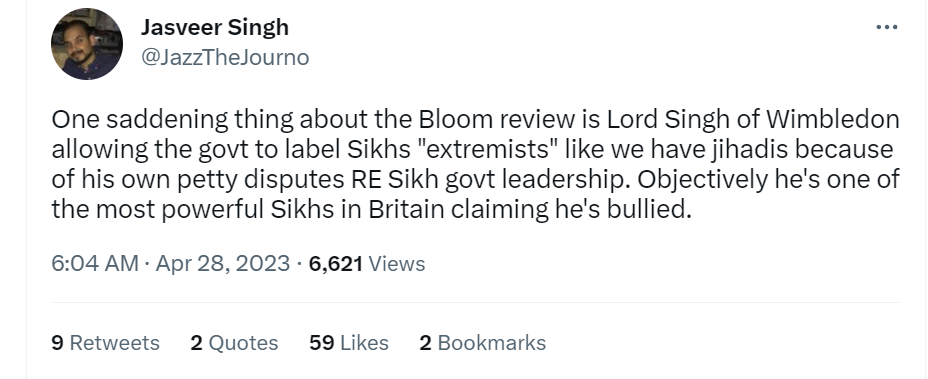
Yesterday, the NSO responded to some tweets referring to the Bloom report. One from Jasveer Singh suggested ‘Lord Singh of Wimbledon allowing the govt to label Sikhs “extremists”‘. This is a false and totally unfounded allegation. It shows a clear ignorance of what transpired.
To set the record straight, the Bloom report included a redacted quote from the Commissioner for Standards investigation (2021) into a malicious and failed complaint made by Preet Gill MP (a prominent Sikh Federation UK (SFUK) supporter) against Lord Singh. Lord Singh was not a respondent to the Bloom inquiry, nor was he interviewed, or contributed in any other way. Ms Gill’s malicious complaint, which was categorically rejected, is available for all to see in the public domain and can be read and cited by anyone. We do not have any control on that, and any suggestion that we do, is frankly absurd. Yes, Bloom used a redacted version of the quote as an example of how SFUK supporters treat people who disagree with them. It’s nasty, vindictive, and malicious behaviour – to steal a phrase from Bloom, one may even say ‘subversive’, but Lord Singh isn’t alone. During SFUK’s Sikh ‘ethnic’ tick box campaign respected academic Dr Jhutti-Johal from the University of Birmingham, (another prominent opponent of the campaign) was treated appallingly by SFUK and their allies.
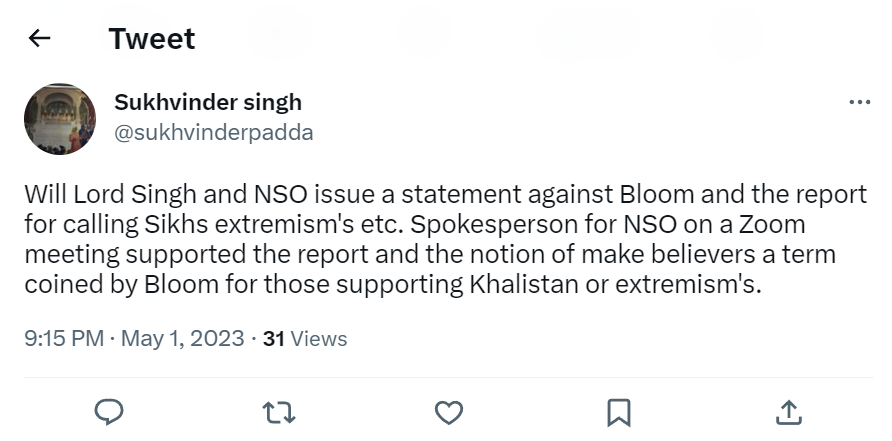
Another Tweeter – SFUK supporter Sukhvinder Padda, yesterday tweeted a ‘Spokesperson for NSO on a Zoom meeting supported the report and the notion of make believers a term coined by Bloom for those supporting Khalistan or extremism’s’. Firstly, Sukhvinder Padda is the same person who issued an apology in 2015 for a libel against Lord Singh. One of our Deputy-Director’s, Hardeep Singh, did indeed attend the Religion Media Centre briefing Zoom call with Colin Bloom. He consciously attended this in his personal capacity as an independent commentator and journalist. His frankly innocuous question was in relation to a separate briefing from Bloom, which categorised people more broadly into hypothetical categories ‘True Believers’, ‘Non-Believers’ and ‘Make-Believers’. He did not mention any group or individual, and simply asked what the community can do to help government distinguish between the said hypothetical categories. He also made it clear that he’d not had the opportunity to ‘digest’ the report in full – let alone endorse or ‘support’ it as has been falsely claimed. He made no mention whatsoever of ‘Khalistan’ or those advocating for it. Padda’s interpretation of this innocuous preamble and question, is at total odds with what transpired and is another example of misinformation. Notably, Bloom’s response to Hardeep’s question included the words, ‘the British Sikh community are just outstanding, and some of the best people we have in the UK.’
We hope the misinformation being propagated on social media comes to a halt, and members of the Sikh community can engage in what is an important and highly sensitive matter for them, with both respect and decorum. Yesterday, the Times of India asked Lord Singh for a quote on Bloom in which he said Sikh extremism, ‘appears to have been magnified somewhat’ and ‘recent government statistics on the religion of terrorists or extremists in British prisons indicate none who identify as Sikh’.
Last night, Jasveer Singh published an apology to Lord Singh, which read, ‘I apologise to Lord Singh of @SikhMessenger for saying he’s allowed Sikhs to be labelled ‘Sikh extremism’ in the Bloom review. Since I said that, he’s said the report “magnified” Sikh extremism, also highlighting no Sikh is in UK prison for terror/extremism.’
FAO: The Rt Hon Suella Braverman KC MP, Secretary of State for the Home Department
As UK faith representatives, we support the ongoing efforts of Home Secretary Suella Braverman, who, in the face of some considerable hostility, has courageously spoken out about the over representation of British Pakistani men in sex grooming gangs operating around the UK. The evidence contained within a number of independent inquiries – Rotherham, Telford, and Rochdale support her position on what is indeed a sensitive and difficult matter.
We as faith communities want the government to acknowledge one of the motivations behind these gangs. We believe evidence points to an inconvenient truth. That is: non-Muslim girls (this includes Sikh, Hindu, and White Christian girls) have been systematically targeted in Britain due to a form of religiously and racially motivated hatred. We believe the ‘othering’ of these victims should be considered as an aggravating factor for the purposes of sentence uplift when perpetrators are brought to justice.
We support Baroness Warsi’s previous position when she said, “a small minority” of Pakistani men see white girls as “fair game” and ask the government to help the Pakistani Muslim community tackle this stain on an otherwise majority law-abiding community.
A Rotherham survivor has confirmed she was targeted for being a ‘white slag’ and because she was ‘non-Muslim’. Judge Gerald Clifton who sentenced men in Rochdale in 2012, made a similar observation in sentencing remarks. He said the Muslim men had targeted their victims because they were not part of the offenders’ ‘community or religion.’
British Sikh and Hindu communities have been complaining about Pakistani grooming gangs since the 1980’s, prior to high-profile cases like Rotherham, Telford, and Rochdale, but complaints have fallen on deaf ears. A television report on BBC1’s Inside Out programme in 2013 was the first high profile media to cover the targeting of Sikh girls, as was coverage in the Times following sentencing of men in Leicester. In recent years Hindu and Sikh community groups have attempted to highlight the targeting of girls within their communities. Despite the BBC interviewing them in 2018, a proposed television report on the issue, was pulled for what we assume to be fear of offending the Muslim community.
The unfortunate consequence of government and police inaction in protecting victims is the hate filled narrative of far-right groups, who maliciously and falsely label all Pakistani Muslim men as ‘groomers’. We can’t allow them to hijack the debate with their poisonous and divisive message, nor can we allow political correctness to stifle obtaining justice for victims by addressing the actions of a minority. Indeed, police failures in protecting young girls from grooming gangs has also contributed to rising community tensions in the UK and has negatively impacted social cohesion.
Although it is good that the ethnicity of offenders is now being recorded, we believe the racial and religious-based motivations behind a significant proportion of perpetrators sentenced in places like Telford, Rotherham, Rochdale – needs to be further explored and openly discussed. Victims deserve justice and deserve to be heard. The first step is being able to discuss the various motivations behind this pattern of criminality freely and fearlessly. Discussion should not be censored by fear of being labelled ‘racist’ or ‘Islamophobic’. We the undersigned therefore unequivocally support the Home Secretary’s brave and principled stand in addressing this serious issue.
Lord Singh of Wimbledon, Director, Network of Sikh Organisations
Mohan Singh Khalsa, The Sikh Awareness Society UK
Dal Singh Dhesi, The Sikh Youth Movement UK
Anil Bhanot OBE, Interfaith Relations Director, Hindu Council UK
Pt Satish K Sharma MBCS FRSA, Director, Global Hindu Federation
Vinod Popat, The British Hindu Voice, Hindu Community Organisations Group
Ashish Joshi, The Media Monitoring Group UK
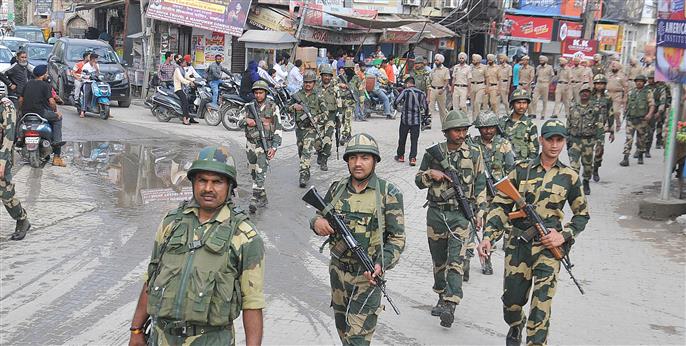
The head of Waris Punjab De – Amritpal Singh became a practising Sikh only recently and has been campaigning stridently for Khalistan. Some of his followers attacked a police station where one of their associates was being held.
Indeed, freedom of speech or discussion should be a fundamental right, but if he or any of his followers have broken the law, then the Indian authorities are within their rights to pursue and investigate them for alleged criminal behaviour.
However, instead learning from Indira Gandhi’s action against Sikhs to boost her standing with a bigoted majority, the government has cynically ordered the clamp down against all Sikhs in Punjab. Indian authorities have been arresting and raiding the homes of human rights activists, with internet blackouts, social media crackdowns, and misinformation being spread across national news by pro-Modi media. Twitter accounts of prominent Sikhs overseas (including politicians in Canada) highlighting India’s record of human rights violations as well as the state’s current clampdown have been censored in India. Respected Indian journalists have also been censored, with the Asia Desk of the Committee to Protect Journalists raising their plight, and journalists overseas have been sent threatening messages for daring to talk about what’s happening.
The state has invoked Section 144 of the Indian Code of Criminal Procedure to reduce gatherings in parts of Punjab, of four or more people and threatening its citizens with charges of rioting if this code is broken. These are draconian measures, which only serve to tarnish India’s reputation as the ‘world’s largest democracy’. Needless to say there have been mass arrests.
No reason has been given for why these draconian measures have been implemented, whilst concerns are of course amplified by India’s reputation of conducting torture, extrajudicial killings, and fake encounters. The collective memory of ‘Operation Woodrose’ post 1984, which targeted many thousands of innocent youth and civilians in Punjab under the pretext of quelling Sikh ‘militancy’ is etched in the psyche of Sikhs worldwide. We only have to look in the rear-view mirror of history to understand why Sikhs are fearful.
Many Sikhs abroad have family and friends in Punjab and fear for their safety and wellbeing. The suspension of civil liberties in a nation which prides itself on being a democracy, isn’t just a threat to the people of Punjab, but to democracy itself.
In the beginning of 1984, the Congress government was trailing badly in the opinion polls, yet went on to win a record majority as a result of its appeal to majority bigotry. The BJP is hoping that it will reap a similar dividend in next year’s election.
A word on Khalistan
Why would Sikhs living peacefully in India want a separate state? The issue did not arise until the increasing discrimination against Sikhs culminating in the genocide of 1984.
In 1984, we all shouted Khalistan, as a shorthand way of saying, ‘we hate the action of the Indian government’. Today some are saying it again following recent action in Punjab. The reality is that a separate religious state, like Pakistan, giving Sikhs controlling power, is not only geographically impossible but also against the teachings of the Gurus who taught equal rights for all. Khalistan is a place where Sikh values of equal treatment for all human beings – justice, compassion, and selfless service prevail.
The Khalistan we must strive for is the spread of these values throughout India and further afield.
[Ends]
Network of Sikh Organisations
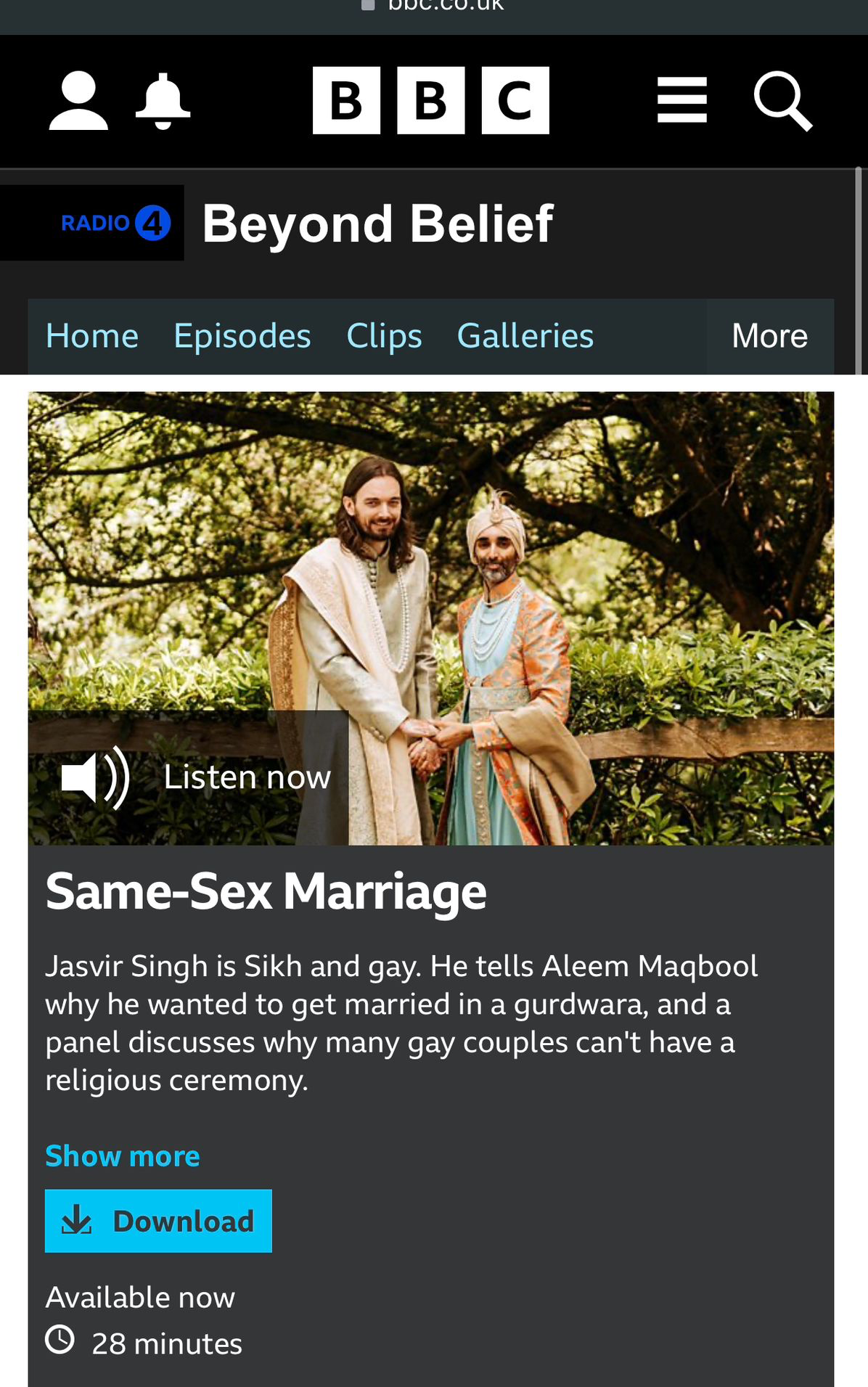
It is well documented and admitted by the BBC that they tried to prevent our Director, Lord Singh, speaking on Thought for the Day (TFTD) about Guru Nanak, the founder of the Sikh faith. He was also pressurised to minimise the contribution of Maharaja Ranjit Singh in promoting harmony and respect between faiths. Unbelievably, after a script of a talk on the martyrdom of Guru Tegh Bahadur had been agreed with the producer of the day, he was asked late in the evening to scrap it and talk about something else. He stood his ground and said that freedom of belief was important to the world of today, and he made it clear that if he was not allowed to talk about Guru Tegh Bahadur, there would be an empty chair in the studio next morning. Faced with this, the producer agreed to the talk going ahead. It was well received.
Our Director complained about the above, and other attempts to belittle Sikh teachings, and in the absence of an assurance that this would stop, he left the TFTD slot after 35 years of broadcasting which won him acclaim from all sections of society. His departure made front page news in the Times and was also the subject of an editorial highly critical of the BBC attempt to censor the tolerant and compassionate contributions of a nationally recognised broadcaster. Thousands of Sikhs signed a petition protesting the BBC attack on Sikh teachings, but to no avail.
Jasvir Singh, an occasional presenter on TFTD chose to remain silent during this flagrant attack on Sikh teachings. He was duly rewarded for his loyalty to the BBC, and made ‘the main Sikh contributor’ on TFTD. The BBC have now rewarded his silence during the attack on foundational Sikh teachings, giving him coverage on the BBC Radio 4 programme – Beyond Belief. They have promoted Jasvir’s gay identity and civil marriage to a non-Sikh. Jasvir tells the BBC that he and his husband received a blessing from a granthi, but went on, ‘could we get married in a gurdwara, sadly the answer was no’, indicating that’s what the couple had intended. The presenter then asks, ‘so why couldn’t Jasvir and his husband Nick have a wedding they wanted within the faith tradition that means so much to Jasvir?’
Sikhism does not condemn homosexuality and Jasvir is of course entitled to choose his lifestyle, but its peculiar that the BBC have described him as a ‘devout Sikh’. This is because Sikhism teaches the Sikh marriage ceremony or Anand Karaj, should be between a man and a woman for their mutual wellbeing, the upbringing of children, and service to the wider community. The Anand Karaj is not an inter-faith or same-sex ceremony.
It is a matter of real concern that after our Director presented the above view of marriage in Sikhism, with appropriate scriptural references to the BBC, it vainly sought others in the community who were unable to effectively articulate that Jasvir’s position on the Anand Karaj ceremony is not consistent with Sikh teachings. Whilst we condemn the threats that Jasvir has received for his sexuality from a fringe minority, Sikh teachings on Anand-Karaj are clear.
Urgent need
Religious broadcasting must have safeguards against attempts by Christian or other producers to belittle, smear or trivialise the teachings of other faiths. There is an urgent need for an Advisory Body to ensure personal prejudices of producers are not allowed to dilute mainstream teachings of other faiths, which should be respectfully and accurately presented in religious broadcasting.
London: (08 Feb 2014); On Tuesday 4th February representatives of many Sikh organisations met with Rt Hon Hugo Swire, Minister MP at the Foreign Office to express concerns over the Cabinet Secretary’s Report on revelations on UK government support for Indian Army action against Sikhs in the Golden Temple.
SUMMARY
UK Sikhs are particularly concerned that despite a promised full inquiry, the Terms of Reference of the Report appear to have been designed to mitigate embarrassment resulting from incriminating documents inadvertently coming into the public domain. The Report of the Cabinet Secretary, Sir Jeremy Heywood is selective in its examination of documentation and concludes that British involvement was minimal. No mention is made of the background of a decade of increasingly active persecution of Sikhs by the Congress government as detailed in reports by Amnesty International and other human rights organisation.
The then Cabinet’s collective bias against Sikhs in the released papers is seen in a consistent labelling of Sikhs with a pick and mix assortment of pejorative descriptions such as separatist, dissident, extremist, fundamentalist etc. to produce a negative image of the community. The documents also showed the absence of a single word of sympathy for the thousands killed in the attack on the Golden Temple on one of the holiest days in the Sikh calendar and the organised widespread killing of Sikhs later in the year. The Inquiry Report instead seeks to show minimal UK military involvement.
The unanswered question remains why and on what criteria the UK government decided to accede to the then Indian government request for military assistance against India’s 2% Sikh community.
DETAILED CONCERNS
1. Trade of greater importance than Human Rights of Sikhs Lord Singh, Director NSO was invited to meet the Cabinet Secretary Sir Jeremy Heywood on 21st January. He explained the hurt and sense of betrayal felt by UK Sikhs over the revelations of British government involvement. The Cabinet Secretary’s response was that his task was simply to look at all documentation and report accordingly. When Lord Singh mentioned that the documents showed that the only concern of the then government seemed to be that a lack of support for the Indian government might jeopardise arms exports, he received the astonishing response from the Cabinet Secretary that he and his team were unaware of any arms trade implications in the papers. Lord Singh responded that he had seen several references to arms sales to India being under threat, and at the Cabinet Secretary’s request, gave his office details of a Cabinet document dated 22 November 1984, referring to a five billion pound arms contract.
· Cabinet papers reveal several other references to arms sale concerns. A two-hour search by an NSO researcher at the National Records Office at Kew, found additional material and importantly evidence of key documents being removed. It has since been confirmed that the missing file related to ‘military intelligence relating to India for 1984’.
· Lord Singh also informed Sir Jeremy Heywood of a personal experience when he went to see a former Cabinet member in November 1984 to express concern over UK government silence over the widespread organised killing of Sikhs throughout India. The staggering response was ‘Indarjit, we know exactly what is going on, it’s very difficult; we’re walking on a tightrope: we have already lost one important contract’.
2. Cabinet papers show that all members of the then Cabinet wilfully ignored the reality of the persecution of Sikhs in India despite evidence then available.
· The UK consistently says that it does not interfere in the internal affairs of sovereign countries. Yet a policy decision seems to have been taken by the 1984 Cabinet to give unquestioning support to a Congress government with democratically tainted credentials in military action against India’s minority Sikh community. The decision ignored widely available evidence of the systematic persecution of Sikhs. This freely available evidence included:
· A detailed report by Amnesty International in 1983 (AI Index: ASA 20/01/84 Distr: SC/CO) documenting widespread human rights abuses by the government.
· A Report by highly respected Hindu civil rights lawyers entitled ‘Who Are the Guilty’, was smuggled out of India in November 84 and personally placed by Lord Singh in the pigeonholes of every MP.
· A presentation was also given to the All Party Parliamentary Group on Human Rights who unanimously decided to send a two man investigating team to India. The Indian Government refused them visas. They appealed saying that their inquiry would help reduce tensions in the UK. They were still refused visas.
3. Censorship of foreign journalists.
· Jane Corbyn, a highly respected journalist from Channel 4, in India at the time of the organised killing of Sikhs in the first week of November, had her film confiscated by the Indian authorities. She did however manage to smuggle a duplicate copy to the UK. This censorship of foreign journalists is mentioned in the documents and was only relaxed after the end of the organised killings of Sikhs throughout India.
· Perusal of the released papers also reveals Cabinet discussions on the need to curb the UK media against allowing any reporting or interviews about or with Sikhs that might offend the Indian government.
· Unhelpful use of pejorative language in Cabinet papers to tarnish the image of UK Sikhs.
· Reading through the documents gives the impression that anyone who expressed concern over the plight of Sikhs in India was immediately labelled an extremist by the UK government.
· The papers show several examples of government pressure on the media to deny Sikhs a voice.
· This use of pejorative language to smear a religious minority (referred to earlier) is underlined by Lord Singh’s personal experience. In November 84, two Scotland Yard officers visited him early on a Sunday morning. They said they were concerned about tensions in the Sikh community and asked Lord Singh if he was ‘an extremist or a moderate’? To emphasise the absurdity of such terms he replied he was ‘extremely moderate’. They then asked if he supported Sikh fundamentalism, to which he replied that the fundamentals of Sikh teachings were about the equality of all human beings, respect for other ways of life and a commitment to work for the betterment of society, ‘Yes I do try to be a Sikh fundamentalist’.
ACTION DESIRED
The present government cannot be blamed for what happened 30 years ago. But the Cabinet in 1984 must have been aware that the day chosen for the attack on the Golden Temple was the martyrdom anniversary of Guru Arjan, (the founder of the Golden Temple) when the huge Temple complex was full to overflowing with innocent pilgrims. The reason given was to remove supposed extremists. The unanswered question is why then were 40 other gurdwaras in Punjab attacked at the same time? Today the UK government should reflect on the continuing hurt of the Sikh community, including the then government giving unthinking support to the cruel and vindictive Mrs Gandhi. To many outside the Sikh community, the events of 1984 are, in the words of the poet, ’dying embers’; to Sikhs they remain ‘red hot coals’ now fanned afresh by the revelation of British government involvement.
The events of 1984 damaged the previous close relationship and mutual respect between the Hindu and Sikh communities. 30 years after the event it is time for an open, independent inquiry that that punishes the guilty and leads to healing and closure.
Two of the three main political parties in India have openly declared their support for such an inquiry, and even Raul Gandhi speaking for the Congress has agreed that there was Congress involvement in the genocide.
Sikhs in the UK call on the government and UK political parties to give their strong backing for a long due open inquiry. In response to a question from Paul Uppal MP, in the Commons, the Foreign Secretary obliquely supported the need for such an inquiry; it should now be given support at the highest government level.
Sikhs are duty bound to stand up for the human rights of all people (Sarbat Da Bhalla), and in this spirit we call on the UK government to show that the subordination of human rights to arms sales to any part of the world is no longer present policy. If the UK government does not do this it forfeits any moral right to lecture other countries on the abuse of human rights.
All Sikh Organisations that attended the Foreign Office briefing showed heartening unanimity in their statements. If we can maintain this unity, we have a real chance in meeting our common objective of an open independent inquiry into the holocaust of Sikhs in 1984.
Please see this link which includes a BBC Television interview with Lord Singh
http://www.bbc.co.uk/news/uk-26027631
 The Golden Temple is one of the holiest shrines for Sikhs
British military advice was given to India ahead of the 1984 deadly attack on a Sikh temple but it had only “limited impact”, MPs have been told.
Foreign Secretary William Hague was delivering the findings of a review into claims an SAS officer helped Delhi plan the raid which killed hundreds.
The storming of the Golden Temple in the city of Amritsar was intended to flush out Sikh separatists.
Mr Hague said UK assistance was “purely advisory” and given months beforehand.
The inquiry was launched last month after declassified documents were said to suggest Margaret Thatcher’s government was involved in planning the raid, called Operation Blue Star.
Official figures put the death toll at 575, but Mr Hague said other reports suggested “as many as 3,000 people were killed including pilgrims caught in the crossfire”.

William Hague said a review had concluded British advice had “limited impact” on the Amritsar operation
“This loss of life was an utter tragedy,” he said.
“Understandably members of the Sikh community around the world still feel the pain and suffering caused by these events.”
 Sanjoy MajumderBBC News, in Delhi
The military commander who led Operation Blue Star, Lt Gen Kuldeep Singh Brar, has told the BBC that he had no knowledge of any advice from Britain to India.
In 2007 a former Indian intelligence officer, B Raman, claimed agents from the UK’s MI5 had visited the Golden Temple four months before the raid. The UK government review appears to corroborate the claim that a British adviser was sent.
But it also appears that the British advice was limited to a few people and certainly not shared with military commanders.
In India, Operation Blue Star has always been seen as a military disaster, which led to the loss of hundreds of lives – including those of civilians – and to the eventual assassination of the then Indian Prime Minister Indira Gandhi.
The latest revelations will only lead to more questions about the assault on the Golden Temple, why it was a disaster and if, in fact, it could have been averted.
Delivering his statement, Mr Hague set out the UK’s involvement in planning for the raid.
He told the Commons that the British government had received an urgent request for help from Indian authorities who wanted to regain control of the temple from Sikh militants.
In response, an unnamed British military adviser was sent to India in February 1984, and he recommended any attack should be a last resort, MPs heard.
The adviser suggested using an element of surprise, as well as helicopters, to try to keep casualty numbers low – features which were not part of the final operation, Mr Hague said.
No equipment or training were offered, Mr Hague said, and the Indian plan “changed significantly” in the following three months, to cope with a considerably larger dissident force and extensive fortifications within the temple complex.
The investigation, carried out by Cabinet Secretary Sir Jeremy Heywood, involved searching 200 files and 23,000 documents.
Prime Minister David Cameron said: “I hope the manner in which we have investigated these dreadful events will provide some reassurance to the Sikh community, here in Britain and elsewhere.”
He added: “A single UK military officer provided some advice. But critically, this advice was not followed, and it was a one-off.”
Retired Lt Gen Kuldeep Singh Brar, who led Operation Blue Star, maintains he had no advice or support from Britain.
“If some things went around months earlier or weeks earlier with other agencies, intelligence agencies, I am not aware of them,” he told the BBC.
“From the time I was given command of Operation Blue Star until I planned it and executed it, let me emphatically tell you that there was no involvement whatsoever as far as the British are concerned.”
 Indian army soldiers moved to flush out Sikh separatists from the Golden Temple in June 1984
Paul Uppal, the UK’s only Sikh MP, said many Sikhs would be “relieved that it was just purely advice that was given”.
He praised the speed and thoroughness of the review and said it could be an “important step” towards “some closure” for Sikhs.
But Lord Indarjit Singh, director of the Network of Sikh Organisations, called Mr Hague’s statement “smug and condescending”.
On the claim that UK advice had a “limited impact” of the Golden Temple attack, Lord Singh said: “It is like saying that I had only a minimal involvement in a massacre or a holocaust.”
He said the language in the documents was “insulting” to Sikhs – suggesting they were all extremists – and the UK’s real motivation in assisting India was keeping its arms contracts.
But Mr Hague said the review had found “no evidence” UK military advice in February 1984 had been “linked to defence sales or any other policy issue”.

Lord Singh, Network of Sikh Organisations: “Why should Britain be involved in the attack on a religious minority”
Jasvir Singh, director of the City Sikhs Network, which represents Sikh professionals in the UK, said the information disclosed in the review “harks back” to colonial times.
“I think there are lots of people in the Sikh community who are upset that the British could be involved in this, even to a limited extent,” he said.
Mr Singh said many details about British involvement in the 1984 attack were still unclear, and called for “transparency” from the authorities.
UK Sikh groups have said the government review should have looked not only at June 1984 but also the events that followed, and Mr Singh also criticised this “narrow scope”.
The Indian government said the UK had kept it “informed on this matter”.
“We have noted the report and the statement made,” an Indian foreign ministry spokesman said.
Indira Gandhi assassinated
David Cameron ordered the review last month after Labour MP Tom Watson said he had seen papers from Margaret Thatcher “authorising Special Air Services (SAS) to work with the Indian government”.
Mr Watson cited two letters released under the 30-year rule. He said a 1984 letter from the prime minister’s office stated that a British adviser had “visited India and drawn up a plan” which had been approved by the Indian government.
Shadow foreign secretary Douglas Alexander said “serious questions” remained about British involvement, and called for all relevant documents to be released.
The Sikh separatists at the Golden Temple in 1984 had been demanding an independent homeland – called Khalistan – in Punjab.
In October 1984 Indian Prime Minister Indira Gandhi was assassinated by her Sikh bodyguards in what was thought to be a revenge attack for what happened at the Golden Temple.
A month later, more than 3,000 people were killed in anti-Sikh riots across India.