Where Unity Is Strength
Header

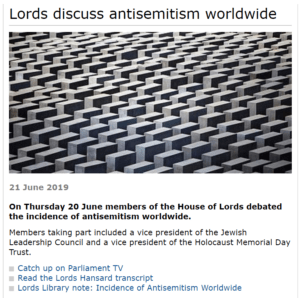
Our Director Lord Singh of Wimbledon contributed to a debate on anti-Semitism secured by Baroness Berridge in the House of Lords this week.

He said, ‘I have visited Auschwitz and seen something of the horrors that thousands of Jews—innocent men, women and children—suffered. In the collective madness of the 1930s and 1940s, Jews were vilified not only in Germany but across much of Europe, including this country. As child I was frequently called a Jew by those who wished to hurt me. However, I believe that talk of a worldwide anti-Jewish conspiracy is misleading and, importantly, takes us away from the real problem which is the way in which unprincipled politicians play on ignorance and majority bigotry, regardless of the consequences suffered by others, to achieve their ends.’

Reflecting on the year we mark the 35th anniversary of the Sikh genocide in India and the persecution of Sikhs in Afghanistan today, he went on:

‘In Germany, Hitler blamed the Jews. In the India of 1984, it was the tiny Sikh minority. The killing of innocents in gas chambers is evil, but is it any more evil than dousing men, women and children with kerosene and burning them alive? In Hitler’s Germany, Jews were made to wear distinctive clothing to show their inferior status. More recently, a decimated Sikh community in Afghanistan has been made to wear distinguishing patches and to fly a yellow flag outside their homes to make them an easy target for majority bigotry. Majority bigotry knows no boundaries and, as my noble friend Lord Sacks reminded us, has no constraints.’

He added: ‘We like to believe prejudice is found in only a few. Sadly, it is far more widespread. We are all, in effect, hard-wired to be wary of difference. Unacceptable but understandable prejudice is easily manipulated to become irrational hatred. Since the Second World War, we have seen unspeakable acts of violence against targeted groups in Cambodia, Rwanda, and Bosnia, and I could go on. Special sympathy-seeking terms such as anti-Semitism or Islamophobia are understandable, but they take us away from the real problem, which is combating the more widespread bigotry suffered by all faiths. To borrow from Shakespeare, if Hindus, Muslims, Sikhs and others are cut, do we not bleed? ‘

Concluding his speech Lord Singh said, ‘Taken to an extreme, this giving of special consideration to some groups at the expense of others is, at best, unintended racism. Bigotry will continue to flourish until, in the closing words of the Sikh daily prayer, we look beyond ourselves and our group to the well-being of all members of our one human family.’

Other contributors included Lord Pickles, Lord Sacks (the former Chief Rabbi), Lord Alton and Lord Finkelstein.


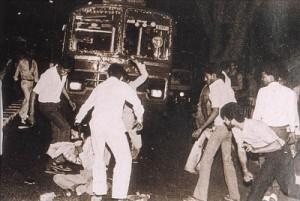
Sikh man being surrounded and attacked by mobs in 1984

During the 1930s and 1940s, Pandit Nehru, first Prime Minister of post-partition India learnt from bitter personal experience of the ease with which a repressive government can label someone an extremist and throw him into gaol. He was quick to learn the lesson from his British mentors and, within months of becoming Prime Minister in 1947, he in turn incarcerated the more prominent of his political opponents – including the veteran Sikh leader Master Tara Singh. The latter had dared to remind him of his promise to the Sikh people 12 months earlier, that he saw nothing wrong with an area being set aside in the north of free India “where Sikhs could also experience the glow of freedom.”

“The situation is different now,” was Pandit Nehru’s comment when reminded of this promise. The Sikh leader was branded “an extremist” and duly gaoled for demanding a measure of autonomy for Punjab that was in fact considerably less than that enjoyed by individual states in the US.

Mr Nehru’s daughter, Indira Gandhi, with all the cynicism and double-talk of dictatorial governments posing as democracies, has been quick to improve on both the language and methods of repression. First in the “emergency”, when all pretence of democracy was dropped, and, more recently, again under the guise of democracy, a cruel feline viciousness has been unleashed on the people of India.

The “emergency” saw the “disappearance” of hundreds of political opponents, the forced sterilisation of the poor, and the destruction of their hovels in the name of progress. In the last two years thousands of “terrorists” and “political agitators” have been shot in Kashmir, Assam and Maharashtra. Now it is the turn of Punjab and the Sikhs. The massacre in Amritsar of perhaps as many as 2,000 mostly unarmed and innocent Sikh men, women, and children – “terrorists” – easily outdoes in barbarity and outrage the 1919 shooting at Jallianwala Bagh where 379 people were killed by General Dyer.

The killings by General Dyer, were in an open park, the slaughter at the Golden Temple was in the holiest of holy Sikh shrines. Indira Gandhi’s justification was that it was a base for Sikh terrorists. Let us look at the facts. The one requirement for terrorism is secrecy. One would not advertise and plan terrorism from, say, the concourse of Waterloo Station. Similarly, the Golden Temple with its famous four doors to emphasise its welcome to pilgrims and visitors from all four corners of the globe, irrespective of race, religion or national origins, had, to say the least, serious limitations that would, religious considerations apart, have precluded its use by any group intent on serious terrorism.

A secret telephone number is a useful asset for organising terrorism. The phones into the Golden Temple were known to, and tapped by the police. Inside, right up to the time of the government attack, pilgrims and visitors, including the foreign press, were free to go into any part of the Temple complex. Outside, a heavy police presence had existed for more than a year around each entrance to the Golden Temple. It is true that, as government threats to enter and desecrate the Temple increased over the months, parallel attempts to build up defences to deter such a sacrilegious attack also increased. The “fortifying” of the Golden Temple was nothing but a response to increasing evidence that Mrs Gandhi was determined to solve the “Sikh question” by striking at the very heart of Sikhism.

Indira Gandhi is right when she says that terrorism must be rooted out. But who are the terrorists? Those perpetrating organised violence, or those that oppose it? It is not generally known outside Punjab that, over the past two years, thousands of Sikh homes in the Punjab villages have been raided by police and paramilitary forces. Young Sikhs have been dragged away for questioning, never to be seen again. The sight of murdered Sikhs floating in rivers and waterways has become a common occurrence. The current issue of the journal of Amnesty International cites several harrowing examples of police brutality and torture. More recently eyewitnesses’ accounts to the Amritsar massacre talk of women and children being shot in cold blood, and Sikh prisoners being tied with their own turbans and then shot in the head. Who then are the terrorists?

The myth of a “terrorist base” borrowed from the vocabulary of more subtle colonial powers, is not the only way in which Mrs Gandhi has allowed truth to be stood on its head. Lack of space forbids a more detailed analysis but the reader trying to find truth in Mrs Gandhi’s press releases might well find the following glossary helpful.

Sikh extremist: One who believes he should be allowed to practice his religion unmolested and that Sikhs and other Punjabis should not be treated less favourably than their brothers and sisters in other Indian states.

Sikh fundamentalist: a Sikh who believes in the fundamentals of the Sikh religion, namely belief in one God, earning by one’s own efforts, helping the less fortunate, religious tolerance, equality of women and universal human brotherhood.

Sikh fanatic: Alternative for Sikh fundamentalist. I. G. Factor: A “multiplier” of 10. Used by Indira Gandhi and Indian government watchers, and based on experience in Kashmir, Assam and elsewhere, to convert press release figures to something approaching reality. For example, the initial Indian government figure of 250 deaths in the Golden Temple converts to 2,500. Eyewitness reports fear that this may be an understatement.

Minimum use of force: “We went in with prayers on our lips” says an Indian General. It is now being reported that the Army was given instructions not to take any prisoners. The coldblooded slaughter of men, women and children.

No alternative: The use of any or all the following clichés to justify excessive use of force-discovery of stockpile of sophisticated weapons; arsenals; bomb factory; involvement of a foreign power, CIA, etc. In the interests of national security: In the interests of Indira Gandhi and family.

Democracy: The inalienable right of a majority to crush minorities. Rule by Indira Gandhi and family, for Indira Gandhi and family.

Indarjit Singh is the editor of the Sikh Messenger, and a member of the religious advisory committee of the United Nations Association.


Courtesy Guardian, first published, 18 June 1984

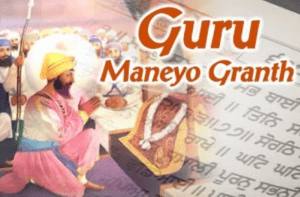
 Guru Maneyo Granth—Guru Gobind Singh
Guru Maneyo Granths-Those who wish to take us back to the worship of gods and goddesses.

The Reality behind the misleadingly named Dasam Granth

The so-called Dasam Granth is a compilation of largely amoral myths and stories produced by Brahmins to fool gullible Sikhs into diluting and distorting the teachings of the Gurus with Hindu mythology.

Evidence

  • Guru Gobind Singh gave Gurgadhi to the Guru Granth Sahib alone.
  • Neither Guru Gobind Singh nor his contemporaries ever referred to any such composition.
  • The first reference to such a composition was made not by a Sikh but revealingly, by a Brahmin called Chibber, 70 years after Guru Gobind Singh.
  • Chibber himself admits that what he wrote was based on hearsay.
  • The first mention of ‘Dasam Granth’ was much later, in 1850 at a time of Hindu resurgence in Punjab.
  • The mischievously named Dasam Granth contains tales of the amorous exploits of Hindu gods and goddesses.The whole notion of gods and goddesses is contrary to Sikh teachings on one God of all humanity (Ek Onkar), who is beyond birth, death and human frailty.
  • The Mool Mantar states that God does not take birth. The Dasam Granth says God took birth 24 times.
  • Sikh teachings emphasise the dignity and complete equality of women. The Dasam Granth denigrates women as lesser beings who are always ready to entice men to their will with their supposed 404 wiles. Women it claims, are ready to resort to intrigues and commit murder to get their way. It says that even God regretted creating such beautiful creatures.
  • In a translation of ‘The Poetry of the Dasam Granth’ former Vice President of India Dr S Radhakrishanan and Dr Dharam Pal, state: ‘in most of the tales, the themes are love, sex debauchery, violence, crime or poison. They are extremely racy and frankly licentious’.
  • Out of respect for common decency, this note does not give examples of these pornographic writings.
  • The so-called Dasam Granth was first propagated by Hindu Arya Samaj extremists, who included in it some compositions, which could possibly be those of Guru Gobind Singh, to make it more appealing to Sikhs. NOTE: These were examined by eminent Sikh scholars in several years of extensive consultation and are listed in the 1945 Rehat Maryada published by the SGPC, as being in consonance with Sikh teachings. The rest of the Dasam Granth was unanimously rejected.
  • In the years following the 1984 holocaust, Hindu extremists have tried to finish Sikhism in the Punjab, and to this end, the Punjab Government produced and distributed thousands of copies of the Dasam Granth, free of cost to many towns and villages in Punjab.
  • One can understand uneducated villagers in Punjab being misled by the word ‘dasam’ sadly, some educated Sikhs in the UK are also being misled to reject the clear and far-sighted message of Guru Gobind Singh sung after the Ardas-Guru Maneyo Granth, consider the teachings of the Guru Granth Sahib to be the sole perpetual guidance for all Sikhs.

[Ends]

Organisations who coordinated the letter to the Home Secretary

A letter opposing a proposed definition for Islamophobia by the APPG on British Muslims has been signed by individuals from across both religious and non-religious communities.

The open letter published here has been brought to the attention of the Home Secretary by groups including the Network of Sikh Organisations, as a warning of the serious consequences adoption of this definition will have on matters of free speech and the ability to legitimately criticise aspects of Islam or the behaviour of a minority of Muslims.

The letter criticises the APPG definition and argues that it, “is being taken on without an adequate scrutiny or proper consideration of its negative consequences for freedom of expression, and academic or journalistic freedom.”

It goes on, “We are concerned that allegations of Islamophobia will be, indeed already are being, used to effectively shield Islamic beliefs and even extremists from criticism, and that formalising this definition will result in it being employed effectively as something of a backdoor blasphemy law.”

The letter has been signed by leading Christians, Muslims, Hindus, atheists and others. It includes Bishop Nazir Ali, Lord Alton of Liverpool, Professor Richard Dawkins, Tom Holland, Peter Tatchell and our Director, Lord Singh of Wimbledon.

Lord Singh said, “The government must tread extremely carefully. There is a real danger adoption of this definition will be weaponised as a tool to silence an important debate in this country.”

He went on, “It is in the interest of the government to listen to minority voices like Ahmaddiyas who face persecution from fellow Muslims, and not create a hierarchy of victimhood amongst different faiths in Britain. Groups like Sikhs without a culture of complaint already face marginalisation, and creation of all these ‘phobias’ does little to promote community cohesion and active cooperation amongst our respective faith communities. The existing legal framework is sufficient to deal with racist and religious discrimination, and we hope the Home Secretary gets a sense of the strength of feeling amongst signatories who oppose this flawed definition.”

For further information contact: info@nsouk.co.uk

[Ends]

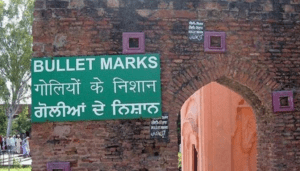
(Image: bullet marks in Jallianwala Bagh, Amritar)

Gurdwaras in Singapore will be holding a minute silence after the ardas (standing prayer) at midday this Saturday 13th April 2019 and the UK should follow suit

This 13th April 1919 marks the centenary of the Jallianwala Bagh massacre in Amritsar. Thousands of peaceful protestors were gunned down following orders by Brigadier General Reginald Dyer, many unaware martial law had been imposed and came to Amritsar to celebrate Vaisakhi. The officially declared death toll was 379 civilians which included men, women and children and over a thousand were injured.

The NSO encourages UK gurdwaras to hold a minute silence this Saturday after the ardas at midday, to remember those who lost their lives in this tragedy described by Churchill as ‘monstrous’ and which former PM Tony Blair said, ‘reminds us of the worst aspects of colonialism.’

Lord Singh, the NSO’s Director said, ‘I strongly urge all Sikhs everywhere to visit their gurdwaras and observe a minute’s silence at midday 13 April 2019 to remember and honour the hundreds of innocent victims mercilessly gunned down in cold blood by British soldiers. The incident made the demand for independence unstoppable.’

[Ends]


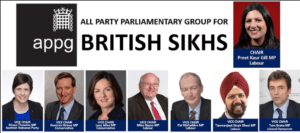
Preet Gill’s statement dated 25th March 2019 on the work of the APPG contains numerous inaccuracies and distortions. A few examples:

On Seva School Coventry she writes:

‘Lord Singh raised the issue of Seva School. As agreed, I wrote to the DFE and received a full and helpful response from Damian Hinds assuring us that the school would not be closed, and they had asked an outstanding Sikh academy trust to take over. I have been in contact with the regional school’s commissioner.’

The reality:

Correspondence is on record to show that she and the Sikh Federation UK (SFUK) – the APPG’s secretariat, have systematically tried to keep Sikhs in the Lords out of the APPG. Despite this, Lord Singh persuaded Lord Suri, to accompany him to a meeting of the APPG on 9th October 2018, at the request of Seva School to help them in fighting a DfE attempt to force the school to join the non-mainstream Nishkam multi-academy trust, rather than a mainstream Sikh Trust. The parent’s concerns were covered in Schools Week. The DfE were not being helpful as Preet Gill writes; they merely repeated their threat that unless Seva School joined Nishkam, considered a New Religious Movement by many Sikhs, they would close the school down. Preet Gill completely ignored the concerns of the Sikh community detailed by Lord Singh and Lord Suri.

Lord Singh and Lord Suri were made less than welcome at the meeting. In response to a query from Lord Singh as to why Sikhs from the Lords were being excluded from the APPG, Preet Gill said that a letter of invitation had been sent by Pat McFadden. Pat McFadden to his credit, openly disagreed, saying that no invitation had been sent to the Lords. Lord Singh said that the APPG office holders should include someone from the Lords. Preet Gill ignored his suggestion. In the meeting and subsequently, Lord Singh asked for minutes of the meeting be sent to him. Despite several requests, the SFUK which acts as secretariat to the APPG has not done this.

Lord Singh, Lord Suri and Baroness Verma have subsequently made their position clear. They strongly object to the extremist SFUK running an APPG which should be for ALL Sikhs in Parliament and are unwilling to be a part of the APPG while Preet Gill and SFUK are in charge. 

[Ends]

The NSO is delighted to report the government has approved an amendment to fully protect the kirpan in law.

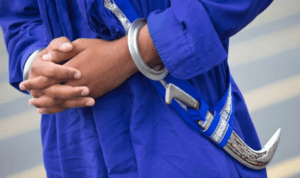
The Offensive Weapons Bill (OWB) went through its third reading in the House of Lords yesterday in which ‘the legal presentation of a curved sword by a follower of the Sikh religion at a ceremonial event’ was discussed and an amendment to fully protect the kirpan passed unanimously. The opportunity to fully protect the kirpan was regrettably missed in the House of Commons.

Yesterday Minister Baroness Williams said, ‘My Lords, I will now speak to the amendments regarding kirpans, and in doing so express my gratitude to the noble Lords, Lord Kennedy and Lord Singh, and my noble friend Lady Verma. They have all been tireless in their promotion of this issue; I hope that the amendments will provide an outcome satisfactory to everyone. In particular, I am grateful to the noble Lord, Lord Singh, for his advice and to the organisation Sikhs in Politics, which has engaged positively with officials on the development of these amendments.’

She went on: ‘As noble Lords will recall, we held a round table on the issue of kirpans following the debate on these clauses in Grand Committee. This identified a gap in the current defences in that the cultural practice of gifting large ceremonial kirpans by Sikhs to eminent non-Sikhs was not covered by the “religious reasons” defence. These amendments will therefore create a defence for a person of Sikh faith to present another person with a curved sword in a religious ceremony or other ceremonial event, as covered by Section 141 of the Criminal Justice Act 1988.’

Lord Singh became aware of the omission referred to by Baroness Williams towards the end of last year. He immediately contacted the Minister before the Bill came to the Lords and, following discussion, raised the issue at the second reading. Because of his standing in the Lords, he received promises of support from all sides of the House.

The Bill then moved to Grand Committee and Lord Singh spoke in detail about the religious significance of the kirpan emphasising that it literally meant ‘protector’ of the weak and vulnerableLord Singh briefed Labour, Liberal and others from all sides of the House to say the same. Winding up for Labour, Lord Tunnicliffe remarked that in all his years in parliament, he could never remember such unanimity.

Lord Singh’s speech at the third reading and the full debate can be read here.

The NSO is grateful to our Director Lord Singh, Lord Paddick, Lord Kennedy, Baroness Verma and unanimous support from cross-party peers to see this important amendment pass. We would also like to extend our thanks to Sikhs in Politics for their support.

[Ends]


Evidence given by the NSO to the Home Affairs Committee on the APPG on British Muslims proposed definition of ‘Islamophobia’ has been cited in an article in the Economist last month.
The article discusses aspects of our submission (along with that of the National Secular Society (NSS)) which we expect to follow up with oral evidence later this year.

We have previously expressed our concern about the vague term ‘Islamophobia’ and the risks it poses to free and open discussion in a submission to the APPG on British Muslims.

The Economist write:

‘The NSS also drew approving attention to an interesting contribution by one of Britain’s religious minorities. The Network of Sikh Organisations made a submission arguing that the term “Islamophobia” could be used to shut down “free and open debate about matters of public interest” including the treatment of minority faiths in Muslim lands, both in the present day or in history. Nor, the Sikhs argued, should concern with Islamophobia be used to give a free pass to conflict within the world of Islam, such as the ostracising of the Ahmadi Muslim sect which had led to two sectarian murders in Britain.’

THE FACTS


  1. The Sikh Federation UK (SFUK) failed to brief their supporter Preet Gill MP, of the need to ensure protection for the kirpan in the early stages of the Offensive Weapons Bill (OWB).


  1. When this was pointed out to them, they met Ministers to introduce protection for ‘religious use’ (which was already protected by the law). They then rushed to self-congratulate with photos with ministers, completely failing to understand that the Bill would prohibit the cultural and ceremonial use of the kirpan.


  1. The SFUK should then have approached a Sikh member in the Lords to try to introduce an amendment to protect the cultural and ceremonial use of the kirpan.


  1. When their colleagues in the Sikh Council suggested this, they argued strongly against Sikhs in the Lords being involved even if the opportunity for protection was lost. They felt that this would draw attention to their incompetence in briefing Preet Gill MP. True Sikhs would have put the needs of the community before their own egos.


  1. Lord Singh, aware of the omission, contacted the relevant Minister before the Bill came to the Lords and, following discussion, raised the issue at the second reading. Because of his standing in the Lords, he received promises of support from all sides of the House.


  1. The Bill then moved to Grand Committee and Lord Singh spoke in detail about the religious significance of the kirpan emphasising that it literally meant ‘protector’ of the weak and vulnerable. Lord Singh briefed Labour, Liberal and others from all sides of the House to say the same. Winding up for Labour, Lord Tunnicliffe remarked that in all his years in parliament, he could never remember such unanimity


  1. What SFUK are now saying in their jealous tweets, about Lord Singh omitting the religious significance of the kirpan, had already been said by Lord Singh and others at Grand Committee.


  1. It is much harder to get an amendment to a Bill in the Lords than in the Commons, and the Home Office (advised by an anti-Sikh group) said that it was difficult to protect a larger kirpan unless there was a clear and easily recognisable description of its physical appearance. Sikhs in the Lords and their supporters saw this as a red herring to create doubt in the minds of the government. A kirpan, whatever its physical appearance, should be protected by legislation for religious and cultural use. There is nothing wrong in saying that in physical appearance a kirpan is a sword to ensure its protection in law.


  1. Following the discussions at Report Stage, government officials have had a further meeting with Lord Singh in working towards a suitable amendment to cover Sikh concerns.


The SFUK in their continuing efforts to smear those that are trying to protect Sikh symbols and identity, while speaking and writing about the uplifting teachings of our Gurus, are again underlining their anti-Sikh agenda.


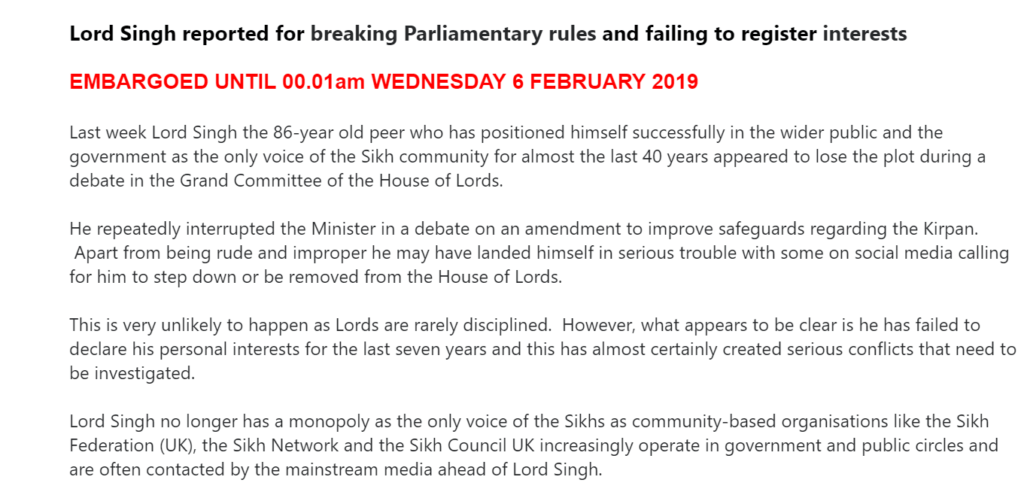
  Sikh Federation UK (SFUK) write:

Last week Lord Singh the 86-year old peer who has positioned himself successfully in the wider public and the government as the only voice of the Sikh community for almost the last 40 years..

Comment:

  1. Why the ageist reference? According to Sikh teachings, it is not age, but ability and commitment that count.
  2. Referring to ‘the 86-year-old peer’ is better than a previous SFUK description ‘a dinosaur’. What is it about the SFUK and references to age?
  3. The SFUK in its different forms has been around for nearly 40 years. Why is it that this one individual has done more to promote an understanding of Sikh teachings in the government and wider public than the whole of SFUK put together?


 SFUK write:

Lord Singh has also been overshadowed in Parliament for the last 18 months by the energetic Preet Kaur Gill, the first Sikh woman MP who became a shadow Minister within months of being elected and Tanmanjeet Singh Dhesi, the first turban wearing Sikh MP. Lord Singh is no longer the only Sikh politician that government, fellow Parliamentarians and the media turn to.

Comment:

This childish ‘you’re not the only one,’ is simply school playground jealousy. The more Sikh MPs, the better.

SFUK write:

However, what Lord Singh failed to disclose in the debate is he is the one and only life-time Director of the NSO.  It now emerges he may not have declared this for the last seven years in the Register of Lords’ Interests, since he became a Lord in October 2011.


Comment:

I am not a lifetime director. All power lies with the elected Executive. They can sack me any time. It is an honorary post for which I do not receive a penny. In last month’s AGM, I specifically requested a diminution in my responsibilities.

Our website will confirm that membership of the NSO requires a commitment to live and propagate Sikh teachings. I believe, that as the first turban wearing Sikh in Parliament, this commitment is seen whenever I stand up to speak. It is appreciation of this commitment to uplifting Sikh teachings that enabled me to get cross-part support for the Amendment.

Why I stated in the debate that the government should consult with myself and the NSO in discussing any reservations about the amendment.

It was I who raised the issue at Second Reading. It was I who subsequently requested a meeting with the Minister, Baroness Williams and her advisers. It was I who had discussions with Lord Kennedy and Lord Paddick.

At the conclusion of my meeting with Baroness Williams it was agreed that they would come back to me. Instead of doing this as courtesy requires, they, ‘in the innocent belief that they are all the same’, then spoke to the SFUK who were naturally unable to respond to the points raised. But for them speaking to the wrong people, the Amendment would have received unanimous approval at Grand Committee. The Government have already apologised for this.

My comment that SFUK does not speak for all Sikhs

I mentioned this because it is true. If it were not true, SFUK would not have lost power in gurdwaras in Leicester, Southampton and their former stronghold in Wolverhampton.

The APPG for British Sikhs

I said the APPG for Sikhs and SFUK were one and the same, because this is true. The Chair is a SFUK sympathiser who appointed them to be its secretariat. There is only one other Sikh member. Four Sikhs in the House of Lords were excluded from its inaugural meeting.

Indarjit

Lord Singh of Wimbledon Director Network of Sikh Organisations (NSO)