|


|
 Britain’s decision to take military action against Syria is like Alice in Wonderland: ‘sentence first-verdict afterwards’, says Lord Singh
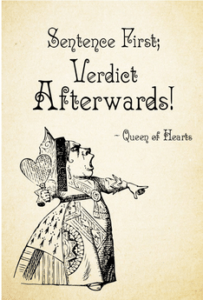
Lord Singh, the Director of the Network of Sikh Organisations (NSO) has said that the Cabinet’s decision to deploy military strikes against President Assad is reminiscent of Alice in Wonderland, citing Alice’s bogus trial when the Queen says, ‘sentence first – verdict afterwards’.
In a scathing speech, the crossbencher spoke out powerfully against the rank hypocrisy of Western military interventions in the Middle East. He cited Britain’s morally reprehensible arms supplies to Saudi Arabia, which continue to be deployed in a bloody war in Yemen against Houthis. Moreover he said he was personally ‘appalled’ when a Minister told him we should not raise human rights issues with China when talking about trade – the Minister’s suggestion here being trade trumps human rights.
Speaking from a Sikh perspective and challenging the established orthodoxy of today’s ‘power-bloc politics’ Lord Singh said, ‘Sikh teachings on the prevention of conflict almost parallel the preamble to the Universal Declaration of Human Rights, formulated after the horror of the Second World War, and they stress the dignity and equality of all members of our one human family. They also legitimise the use of military force only as a last recourse when all other means have failed.’
Lord Singh said, that he found propaganda justifying military intervention in reported government statements as ‘morally questionable and hypocritical’. He said, Assad is no angel, but like many other leaders in the region we [Britain] have ‘propped up’ a brutal dictator. He said countries that we don’t like become to be known as ‘regimes’, and Assad himself has been referred to as a ‘monster’, which could be counterproductive if Britain is to be involved in future negotiations on the Syrian issue, something the PM has indicated to be a possible solution to the conflict.
He said, ‘I am saddened by the hypocrisy of our government and the governments of the USA and France. While wringing their hands about the monster Assad’s supposed chemical weapon attack on little children, they have all in the last two or three of weeks signed billion-dollar deals with Saudi Arabia to export arms for use in Yemen, so that Saudi Arabia can strut its military might in the Middle East with the continued bombing of men, women and little children in Yemen.’
He went on, ‘We are then expected to believe that President Assad, having secured control of much of the country, suddenly decides to launch a chemical attack on a children’s hospital. It could be true, although it sounds implausible, but it gave the US President an opportunity to withdraw from the conflict flourishing his military might. France and Britain dutifully backed him in a combined military strike against Assad. President Trump predictably tweeted “Mission accomplished”. It is sad that our PM should feel duty-bound to back military action prior to any investigation. I thought that it was only in Alice in Wonderland that we had the saying, “Sentence first—verdict afterwards”.’
In conclusion he said, ‘The whole concept of supposed strategic interest has, over the centuries, been shown to be deeply flawed and a recipe for continuing conflict. A Christian hymn reminds us: “They enslave their children’s children who make compromise with sin”. It is a truth echoed in Sikh teachings and in the Universal Declaration of Human Rights. The only strategic interest worth pursuing is respect for human rights and social justice for all and for future generations in our highly interdependent world.’
Lord Singh’s full speech can be read here.
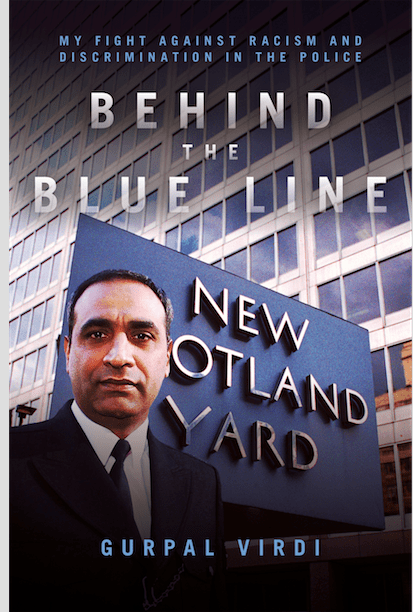
Image courtesy of Biteback Publishing
If ever you need a reference point on one man’s battle against institutional racism, then we recommend you get a copy of Gurpal Virdi’s book out today – Behind the Blue Line.
It is fair to say Virdi has been through it all. In 1998 as a police Sergeant in the MET he was falsely accused (and dismissed) for sending racist e-mails to himself, and other BAME officers and was subsequently exonerated. On his reinstatement to work, he says his career was essentially over because he’d spoken out and challenged racism in the police. However, what would have deterred a lesser man didn’t stop Virdi. He has successfully taken the MET to two industrial tribunals for discrimination, and bravely gave evidence to the Macpherson inquiry into the death of Stephen Lawrence – when he knew of the consequences. He is also the subject of the VIRDI inquiry report.
After his retirement, in 2014, he decided to enter local politics as a Labour candidate. Just before the election, he was falsely accused by the MET of a sexual offence against a minor and abandoned by many of his friends, so called colleagues and the Labour Party. He stood and won as an Independent. In 2015, a jury took 50 minutes to clear him of charges from an alleged incident in 1986. The presiding judge, His Honor Judge Andrew Goymer said a conspiracy may be behind the case. Despite his lengthy battles for justice and equality, Virdi remains a man who encompasses the Sikh ethos of chardi kala, or everlasting optimism.
We at the NSO have worked with Gurpal Virdi for many years and collaborated with him during his role at the Metropolitan Police Sikh Association (MPSA). Our Director, Lord Singh of Wimbledon was incensed at the allegations leveled against Virdi in 2014 and supported him during the trial.
We don’t often give book recommendations, but Gurpal’s journey in Behind the Blue Line is the rare exception as an injustice can happen to any one of us.
The Mirror’s recent article on grooming gangs highlights the best of British journalism, but we have filed a complaint to IPSO regarding use of the term ‘Asian’
The term ‘Asian’ continues to be regrettably used as a euphemism, when it comes to the identity of those convicted in the majority of Britain’s sexual grooming cases. The report in the Mirror last Sunday focusing in on Telford, rightly describes this horrifying issue as an ‘epidemic’. Whilst we are indebted to the investigative journalists behind this important report, the continuing smearing of ‘Asians’ per se is appalling, as the term encompasses swathes of communities from across the Indian subcontinent. This cowardly non-specific description of the perpetrators continues to be used in the British press, to describe men of predominantly Pakistani Muslim heritage convicted in grooming gang cases. We believe this is in part due to the fear of offending Muslims.
The media’s reluctance to describe perpetrators of these despicable crimes with clear and honest language, has elicited angry responses from Sikhs and Hindus, who’ve contacted us to express their outrage following the Mirror’s article. It has upset Pakistani Christians too. To put it frankly, the word ‘Asian’ gives the false impression gangs of Indian, Thai, Japanese or Korean men are rampaging across Britain sexually abusing underage white girls on an industrial scale. Is that fair? We suggest that this vague terminology isn’t only an insult, smearing innocent communities, but also serves to mask the fact that girls from Hindu and Sikh communities have historically fallen foul of grooming gangs themselves. The common denominator in such cases is the deliberate targeting of non-Muslim girls, which we believe should be categorized by the police as a hate crime.
Although we applaud the bravery of Nick Sommerlad and Geraldine McKelvie for their excellent journalism in the Mirror’s report, the NSO has reluctantly chosen to file a complaint to the Independent Press Standards Organisation (IPSO), because of the liberal use of the word ‘Asian’ in the article to describe the identity of the offenders. Given the importance of their work, we did not take this decision lightly. However, we believe use of the word ‘Asian’ to describe sexual grooming by men of predominantly Pakistani Muslim heritage, whilst being both irresponsible and inaccurate, masks the real identity of those perpetrating these heinous crimes.
Network of Sikh Organisations (NSO)
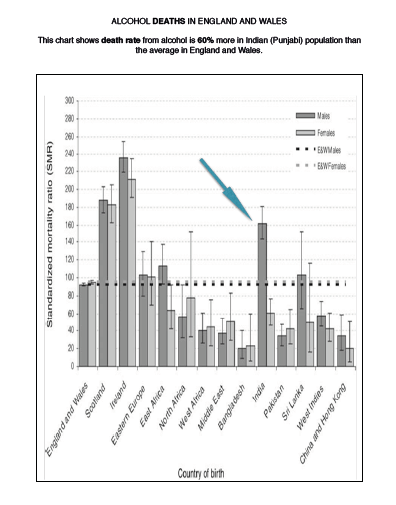
(Above: graph from Dr Pannu’s paper showing mortality relates related to alcohol abuse amongst different groups)
Dr Gurprit Singh Pannu’s editorial on the consumption of alcohol amongst different groups has over the years highlighted a troubling trend for Indians, and in particular Punjabis among them. It is well known that the Scottish and Irish have higher rates of alcohol consumption compared to England and Wales. However a recent paper shared by Dr Pannu on social media indicates Indians, (of which Punjabis are the most significant proportion) have a 60% higher mortality rate from alcohol use when compared to the average in England and Wales. This startling statistic is supported by evidence that indicates higher hospital admissions rates, (including psychiatric ones) than the general public. We all have a responsibility to reduce these admissions and deaths within our community.
To be clear Dr Pannu isn’t talking about the majority of Punjabis who drink socially, but a minority who end up on a slippery slope, which eventually leads to higher mortality rates, and associated social problems. Criminality, domestic violence, workplace problems and social disorder are just some of the consequences pointed to in the paper. Just on domestic violence, according to Dr Pannu’s paper a third of all cases nationally are linked to alcohol abuse, with over one million children affected by their families problematic circumstances.
Although the consumption of alcohol is strictly prohibited in Sikhism, the Punjabi contingent highlighted by Dr Pannu of course includes those of Sikh heritage, who are culturally predisposed to drinking. This admittedly could be either Punjabi culture or British pub drinking culture, given these statistics would incorporate British born Punjabis as well as those born in India. It is interesting to note that those of Pakistani heritage, presumably because of stricter adherence to alcohol prohibitions in Islam, have significantly lower alcohol related death rates than Indians. It is a matter of huge embarrassment that non-Sikhs who attend Sikh weddings often marvel at the free flowing bottles of spirits and alcoholic beverages available at receptions, walking away with the wrong impression Sikhs are permitted to drink.
The NSO has supported Dr Pannu’s positive work over the years, and to this end we will be organising a series of workshops with experts to discuss the issue of alcohol abuse among Punjabis. We acknowledge there is a lot of good work out there already, however one of our aims will be to signpost families to access appropriate medical services and local support network’s essential for the process of rehabilitation from alcohol abuse. This knowledge must be readily accessible to all, and we look forward in working with Dr Pannu and allied healthcare professionals to address a social ill we cannot afford to ignore.
Dr Pannu said, ‘Alcohol misuse in Punjabi men is driving a large excess of admissions to general and psychiatric hospitals with 60% higher death rates than the rest of population in England. There is also evidence that Punjabis are more susceptible to organ damage caused by alcohol.’
He went on, ‘These people represent just the tip of the iceberg, with community studies showing high rates of liver damage in apparently well people. Also the associated social problems are often hidden from view. The solutions include prevention. How can we as Punjabis reduce our overall drinking to amounts similar to the general population? This is the key to stopping unnecessary pain and suffering in Punjabi families.’
The NSO’s Director Lord Singh said, ‘I am delighted to support this important initiative. Dr Pannu gave a thought-provoking presentation to a meeting of the NSO a few years back in which he highlighted the serious and disproportionate problem of alcohol abuse in the Punjabi community and we have continued to act on his advice and guidance. Despite clear warnings in Sikh teachings against the use of intoxicants, alcohol abuse is sadly all too evident among some in the Sikh community, leading to serious health effects, domestic violence and family breakdown. Many Sikhs in prisons are there for alcohol related crimes.’
He added, ‘Guru Nanak reminded us that the consumption of alcohol dims our awareness of our priorities and responsibilities. The proposed workshops recognise a real problem and will help many to get back to the direction of the Guru’s teachings.’
Back in 2008 Faith Matters, the organisation behind Tell MAMA (the Muslim hate crime monitor) organised a ‘cohesive communities’ project for British Sikhs and Muslims to address, ‘the growing gulf between Sikhs and Muslims in certain localised areas of England’. It was held in Corrymeela (Ballycastle) between 4th-6th July 2008, a centre famous for conflict resolution at the height of sectarian troubles in Northern Ireland. According to FOI disclosures seen by the NSO the project cost the taxpayer £33,600.
Following the residential course four (out of nine) of the Sikh participants felt disgruntled enough to publish what they called an ‘Alternative Report’, (dated 1 October 2008) to express their concerns. They wrote: ‘In the view of many Sikh participants, the whole exercise proved faulty and dysfunctional; and failed to enable a wholesome and engaged dialogue on the critical Sikh-Muslims issues.’
In the same year the founder of Faith Matters, Mr Fiyaz Mughal, talked about the project in an article published by Faith Matters titled: ‘Cohesive Communities: Bridging Divides Between Muslim and Sikh Communities.’ He writes: ‘As the name suggests, the Cohesive Communities project was a chance for key issues to be aired and a start to the interaction process between both faiths. It was not meant as a basis to provide legitimisation for either community to use the report or its findings against the other and we firmly adhere to this principal.’
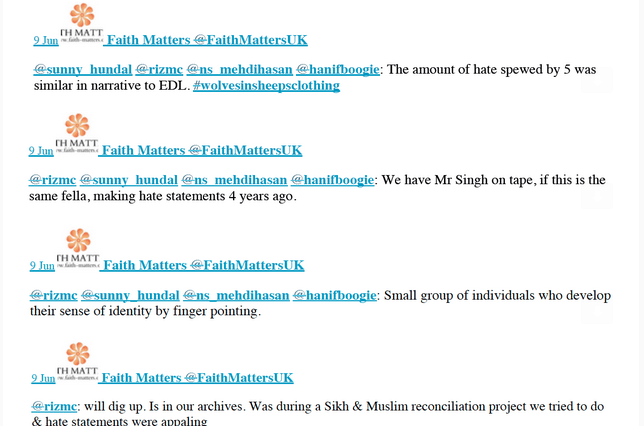
Despite the assurances given above, in June 2012, the following tweets (which were later removed following a complaint) making derogatory references to Sikh participants in Corrymeela were published by @FaithMattersUK.
We understand Faith Matters/Tell MAMA has recently organised a ‘round-table’ to discuss hate crime with Sikhs. This is in fact an area in which Sikhs led by the NSO have made significant progress, firstly by unearthing a breakdown of data from the MET police (through FOI) that shows significant numbers of non-Muslims, or those of no recorded faith (in 2015 and 2016) are being recorded under the ‘Islamophobic hate crime category’. In addition, we have a firm commitment from policy makers on a specific project for Hindus and Sikhs with True Vision – the police hate-crime reporting portal, which we hope to progress with our partners in the Hindu community this year.
We believe the 2012 tweets made by @FaithMattersUK, particularly the comparing of Sikhs who entered interfaith dialogue in good faith with Faith Matters to the EDL, and the accompanying hashtag #wolvesinsheepsclothing, are simply not compatible with the aim in creating harmonious relations between British Sikhs and Muslims, or promoting the concept of ‘cohesive communities.’
In the circumstances, it is our advice that Sikh groups should be wary of any partnerships, given what we view to be a previous betrayal.
Network of Sikh Organisations
 The issue of extremism and indoctrination in schools was debated in the House of Lords this week following a question tabled by Lord Storey who asked the government, ‘what steps they are taking to ensure that children and young people are not being indoctrinated in schools.’
Peers discussed Ofsted’s initiative in identifying unregistered schools, which resulted in the closure of 34 or so schools, the establishment of a counter-extremism hotline, which has been utilised by educators a total of 450 times since April 2015, and difficult situations in which teachers have faced intimidation when they try to address extremism or indoctrination.
The issue indeed has wide implications for British society, and has affected amongst others Sikh educators. During the time of Trojan horse affair in 2014, it was reported that a Sikh heritage principal Balwant Bains, stepped down from Satley School and Specialist Science College due to relentless criticism from a Muslim dominated board. Last month another British born Sikh, Neena Lall head of St Stephens School in Newham received a backlash following a board of governor’s decision to ban the hijab for girls under the age of eight. Following a concerted campaign by conservative elements, (part of which included a spoof video in which Lall was compared to Hitler), the school reversed their decision. This resulted in an unprecedented intervention in support of Lall from Ofsted’s chief inspector Amanda Spielman.
Contributing to the debate Lord Singh, the Director of the Network of Sikh Organisations (NSO) said, ‘My Lords, does the Minister agree that all the main religions should be taught in schools and that if a school is not doing that, it is a failing school? Should not the teachings of religion be in the context of today’s times rather than literally in the language of outdated texts, which can be manipulated for the purposes of extremism? Does the Minister further agree that the teachings should focus, not so much on customs and rituals, but on the underlying ethos so that it becomes self-evident that the different religions are all pushing in the same direction?’
The Parliamentary Under-Secretary of State for the Department of Education – Lord Agnew of Oulton stressed extremism had no place in British society, and a change in law meant all schools must actively promote British values. He said, ‘If there are any allegations of schools promoting ideologies or discrimination in the classroom, we will not hesitate to take action.’
 The Home Affairs Committee inquiry into hate crime and its violent consequences have published our second piece of written evidence which can be viewed here.
We are delighted that one of our policy recommendations from last year was heeded by Ministers, but it still needs to be implemented. We will be pushing for action on this specific commitment to Hindus and Sikhs, and would like to see the initiative implemented this year.
Despite this limited success, the NSO continues to be disheartened by the government’s lack of parity when it comes to the suffering of non-Abrahamic faith communities. Especially given FOI disclosures to us (for 2015 and 2016) from the MET police revealed significant numbers of non-Muslims including Sikhs, Hindus, Christians, Jews, Buddhists, Atheists and Agnostics are being recorded as victims of ‘Islamophobic hate crime’.
We will continue to hold the government to account on what has clearly become a bias and ‘Abrahamic-centric’ policy approach to hate crime.

Baroness O’Loan during debate on conscientious objection
Our Director Lord Singh has supported a Bill designed to afford necessary protection for careers of medical practitioners who choose to object on grounds of conscientious objection when it comes to matters of life and death such as assisted suicide.
The Conscientious Objection (Medical Activities) Bill introduced by Baroness O’Loan had its second reading in the House of Lords last week. According to Baroness O’Loan the Bill ‘seeks to affirm as a matter of statute that nobody shall be under any duty to participate in activities they believe to take a human life. That means either in the withdrawal of life-sustaining treatment, or in any activity authorised by the 1967 and 1990 Acts (including activity required to prepare for, support or perform them).’ Baroness O’Loan believes such reform would re-establish legal protections for medical conscientious objectors, reaffirming Article 9 rights.
Lord Singh the NSO’s Director who has previously opposed Lord Falconer’s Assisted Dying Bills, in favour of ‘assisted living’ said:
‘My Lords, I support this important Bill. It is a timely recognition of the importance of conscience and ethical belief in looking at the end-of-life decisions, and the increasingly complex issues and personal dilemmas, that many face in their daily lives. Speaking from a Sikh perspective, I fully support the Bill’s sentiments as well as its aims and objectives. Majority opinion can, at times, be unthinking and we need to be wary of being pushed, or pushing others, to support debatable attitudes that at times affront ethical and moral principles.
This year, as has been mentioned, while commemorating the centenary of the end of the carnage of World War I, we should pause and reflect that it was also a war in which conscientious objectors were brutally treated—or even shot—for their belief that it is wrong to kill.’
He went on: ‘Something of the same dilemma was faced by Sikh soldiers when the Indian army attacked the Golden Temple in Amritsar in 1984. This attack on the holiest of Sikh shrines, on one of the holiest days in the Sikh calendar, was clearly political. Soldiers were ordered to shoot innocent pilgrims. Not surprisingly, some Sikh soldiers refused and were accused of mutiny. Some were shot, others were cashiered out of the army and some were to spend years in prison. They were accused of treason and disloyalty to their oath of allegiance to the state. True, yet in refusing to shoot non-combatants they were being true to the ethical teachings of their religion. This requirement to be true to our conscience is embedded in Sikh scriptures.
Guru Ram Dass, the fourth Guru of the Sikhs wrote:
“All human powers men make pacts with
Are subject to death and decay
Righteous teaching alone prevails”.’
Lord Singh continued: ‘In the Nuremberg trials at the end of the Second World War, many Germans accused of war crimes against the Jews and others pleaded that they were duty bound to follow orders, however questionable. The court held that the requirements of any state were secondary to the overriding norms of civilised behaviour.
Rapid advances in the field of medicine and today’s increasing tendency to overfocus on the rights of an individual can easily lead us to ignore the rights of wider society, and the ethical dilemmas that sometimes questionable procedures pose for those immediately involved. The downside of what we do is not always immediately apparent. The initial, clearly limited and humane objectives of the Abortion Act 1967 have, over time, been largely ignored. Abortion has become contrary to the original intentions of the Act and the ethical teachings of most religions and beliefs. It has simply become another method of birth control. We must have the right to object and to not take part in what we consider to be the unnecessary taking of human life.
The Human Fertilisation and Embryology Act 1990, which legalised embryo- destructive forms of research, the rapid expansion in molecular biology and new genetic modification techniques can impinge on deeply held ethical beliefs, and people should not be compelled to do anything that they believe is contrary to respect for life. While conscience clauses were included in the initial legislation, they have been continually eroded by social pressures to conform. Those involved in procedures that impact on sincerely held ethical beliefs must be given the right to opt out.
The need to respect conscience goes beyond the field of medicine. Yesterday, I was invited by the DfE to give a Sikh perspective on relationship teaching in schools. As a Sikh, I am appalled at the undue emphasis on sexual relationships and sexual identity currently being taught in school. Young children are led to question their gender and are unhelpfully offered support to make permanent potential differences, which are generally passing phases in growing up. Parents and teachers should have a right to question or opt out of such teachings.
Today we should heed the words of the great philosopher James Russell Lowell who wrote:
“We owe allegiance to the State; but deeper, truer, more
To the sympathies that God has set within our spirits core”.
This Bill is timely, well considered and necessary. I give it my full support.’
The full debate can be read here https://nsouk.us12.list-manage.com/track/click?u=0f788213c84a862348b0c4265&id=8882ff4ae1&e=39e8e2ed33.
The Bill will now pass on to a committee stage in the House of Lords.
 Outsourcing is clearly a growth industry. If we make a call to any service provider it might well be answered by someone in Mumbai or Bangalore. It’ something we all face every day. As we juggle our complex personal lives, we can find ourselves entrusting the care of our children to childminders we sometimes scarcely know.
This outsourcing of responsibility goes much wider. Questions to ministers in Parliament, are often couched in terms of: ‘what is the government going to do about the care of the elderly, the grooming of vulnerable children, hate crime, knife crime, obesity, alcoholism, the dangers of the social media and much else. Over the weekend we had dentists calling for the government to act over an alarming rise in tooth decay in young children often caused by too many sugary drinks. These are complex social issues which can never have a single answer. With the best will in the world, government policy cannot simply make up for the neglect of personal responsibility.
Escaping personal responsibility is nothing new. In the India of Guru Nanak’s day, people would sometimes leave their families to wander in the wilderness in a search for God. The Guru criticised this abandonment of social responsibility and suggested that they go back home and look to the care of their families and wider society.
I was reminded of this while attending the official opening of a new, Sikh ethos school in Leeds recently. Running through the school’s DNA is an underlying ethos, common to many faiths and beliefs, of commitment to personal responsibility and service to those around us.
I was given a tour of the school with the Lord Mayor of Leeds, Councillor Jane Dowson. Brightly coloured posters on the walls, and writing in exercise books, emphasised what I think of as the often missing other 3 Rs: Right, Wrong and Responsibility. The Lord Mayor looked at the list of British Values prominently displayed on one wall, and then at the summary of the essential ethos of Sikh teachings on another, and said they are one and the same! She continued, ‘if only we could get adults to live by such values’. Not easy. But a little less outsourcing of personal responsibility, can have huge benefits for us all.